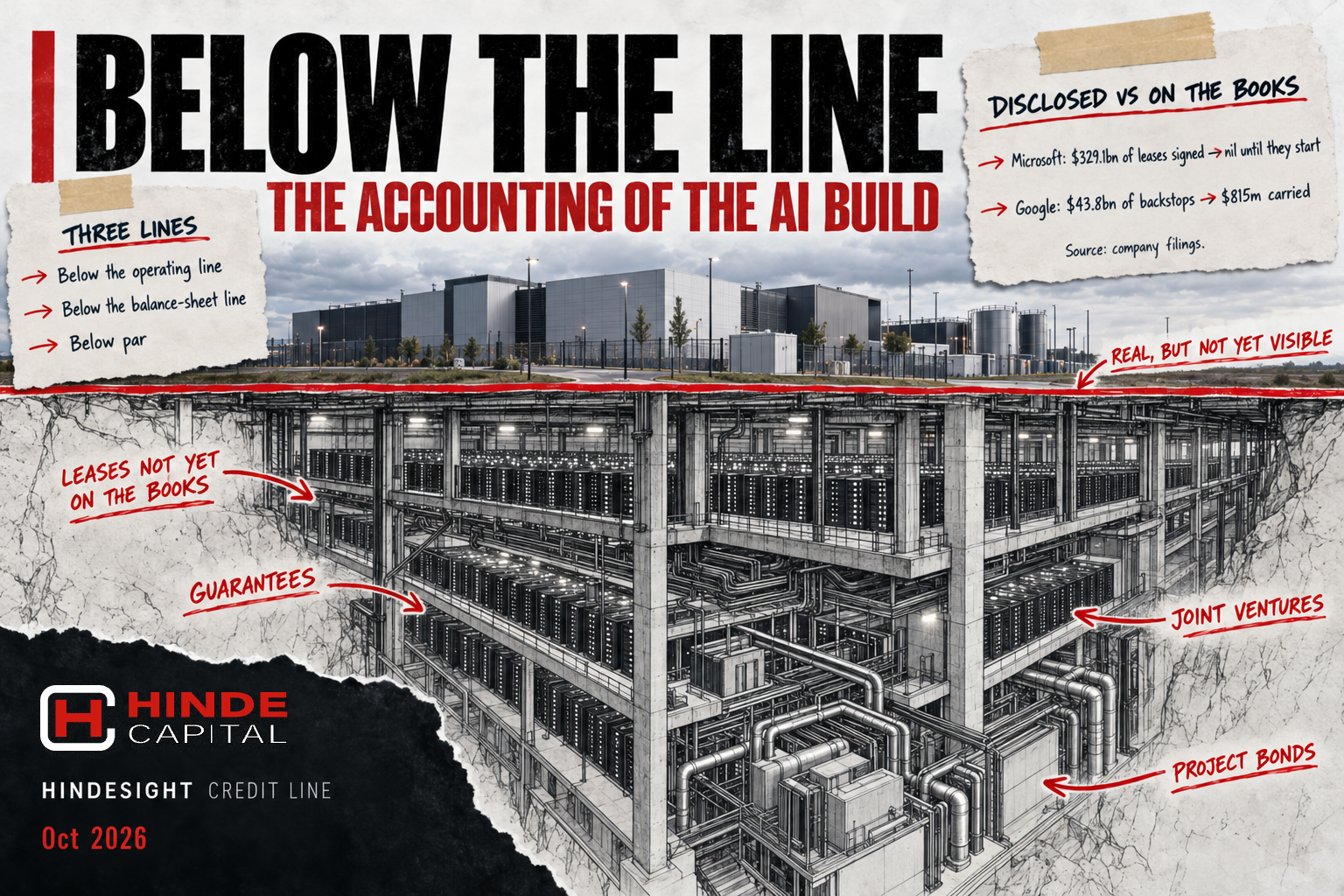
Below the Line
Two Kinds of Profit
In the second quarter of 2026 Amazon earned $27.5 billion from running its business. It earned a further $53.4 billion from owning part of a customer.11 Amazon 10-Q, Q2 2026 Most of the second figure came from Anthropic, whose latest funding round lifted the carrying value of Amazon’s preferred shares by $50.5 billion. No cash changed hands. The gain is legitimate, audited and disclosed, and it took net income for the quarter to $62.6 billion, more than twice what the business itself produced.
That single line of an income statement holds the subject of this piece. Every number in the AI build is legitimate under its own standard. The risk sits in what each standard leaves out, and in who holds the obligation once the listed company does not.
Since August, HindeSight has followed the credit cycle running underneath the AI build. A Credit Cycle Wearing AI’s Costume set out the thesis, the September series traced the network and its first stress at Jupiter, and Catch-22 asked whether the build can be delivered in time and at a viable cost. Each met the accounting one instrument at a time: leases signed years before they are recognised, project debt that depends on the largest cloud providers, the hyperscalers, without belonging to them, and guarantees disclosed at their maximum and booked near nil. Taken together, the claims, liens, leases, guarantees and side agreements become hard to follow, even for those who track them closely. Below the Line gathers them in one place: every credit structure the Credit Line letters have touched, and how each is accounted for, or not, as the case may be.
The rules come in two accounting families. US generally accepted accounting principles (GAAP), organised by topic in the Accounting Standards Codification (ASC), govern the American companies at the centre of the build. International Financial Reporting Standards (IFRS) govern most reporters elsewhere. From them, twelve principles decide when a promise becomes a number on a financial statement, and if and where that number lands. Each section below takes one principle, shows what it does to revenue, earnings and cash, and names the practices it permits, with examples drawn from annual (10-K) and quarterly (10-Q) filings. A glossary at the end defines every term, and the figures use the same words.
The title is the thesis in three phrases. Below the operating line, where a customer’s funding round becomes a supplier’s profit. Below the balance-sheet line, where commitments sit in footnotes, joint ventures and guarantee notes. Below par, where the credit market prices what the accounts do not yet show. Each is a place where an obligation is real but not yet visible.
Nothing in the cases that follow alleges wrongdoing by the companies named, albeit one could consider some practices somewhat disingenuous. Every practice described here is permitted, and most are sensible on their own terms. The companies named are case examples, chosen to illustrate the twelve principles; they are not an exhaustive list.
That is not the same as saying all is well. Between 2005 and 2008 there was outright fraud as well as aggressive accounting, and the worst of it surfaced only after the bust. New Century, the subprime lender whose collapse opened the 2007 clock in the October letter, had understated the reserves it needed against bad loans; its bankruptcy examiner found the accounting improper, and the SEC later charged three former executives with fraud.22 New Century examiner, 29 Feb 2008; SEC, 7 Dec 2009 Lehman’s Repo 105 transactions, which moved some $50 billion off its balance sheet at quarter ends, were laid out in full only in the bankruptcy examiner’s report of 2010.33 Lehman examiner (Valukas), 11 Mar 2010 The SEC charged Countrywide’s chief executive, Angelo Mozilo, with fraud and insider trading; he settled in 2010 for $67.5 million, without admitting or denying the charges.44 SEC, 15 Oct 2010 S&P later paid $1.375 billion to settle US government claims that it had inflated ratings on mortgage securities,55 US Department of Justice, 3 Feb 2015 and the monoline insurers Ambac and MBIA, which had lent their AAA ratings to much of that paper, lost them in 2008. Ratings manufactured through guarantees and packaging sat at the centre of that cycle.
I believe the same is happening now. Some rather opaque off-balance-sheet deals are being done, and many a forensic analyst is already digging into them. Much of this credit appears to be cut and packaged, tranche by tranche, to reach the single-A ratings that let insurers hold it with little capital set aside. The US insurance industry has roughly $9 trillion of invested assets, and record annuity sales are pouring hundreds of billions of new money into it, much of it looking for exactly this kind of paper.66 Ares, In the Gaps, Fall 2026 As before, the proof is likely to arrive after the cycle turns, not before. How the packaging works, and who ends up holding it, I will endeavour to explore further in the next Credit Line, in November.
The question for this piece is what the permitted practices alone add up to. An obligation that is real in economic substance can travel a long way before any set of accounts has to show it.
The Twelve Principles at a Glance
The grid maps each principle against the lines a reader watches: revenue; earnings before interest, tax, depreciation and amortisation (EBITDA); operating income; net income; operating cash flow; free cash flow (FCF); and reported debt. Red marks where a permitted practice flatters the number (i.e. inflates). Switch to the Cases view and each red cell names an example of a company and figure that show a particular practice.
Two patterns stand out. The flattering is concentrated in reported debt, the line a lender most wants to trust. And almost none of it touches revenue, which is why the growth looks clean. No surprises there then.
The twelve principles, in one line each:
- 1Signing is not recognition. A contract reaches the accounts when performance starts, not when it is signed.
- 2Rent, purchase or service. The label on a contract decides whether it shows as debt, as capex or as an operating cost.
- 3Where the boundary falls. A company consolidates only what it controls, so a project it depends on can sit off its balance sheet.
- 4Guarantees, backstops and credit derivatives. Promises to pay if someone else does not are disclosed at their maximum and booked near nil.
- 5The depreciation clock. Asset lives, construction in progress and capitalised interest decide when the cost of the build reaches earnings.
- 6Whose money pays the bill. A sale is booked in full even when the seller has funded, lent to or guaranteed the buyer.
- 7Below the operating line. Gains on stakes in private customers lift net income without touching revenue or cash.
- 8Where the cash shows up. The same payment can be labelled operating, investing or financing, and because free cash flow counts only operating cash less capex, the label alone can raise or lower it.
- 9Terms, options and the discount rate. Short committed terms, renewal options and discounting shrink the liability a long commitment produces.
- 10Seen from one chair. Each company reports only its own side of a contract, so no one reports the whole.
- 11Where the claim lands. Once debt leaves the borrower, each holder marks it under its own rules, often slowly.
- 12Same contract, different numbers. US rules, international rules and the rating agencies give the same contract different figures.
| Principle | Revenue | EBITDA | Operating income | Net income | Operating cash flow | Free cash flow | Reported debt |
|---|---|---|---|---|---|---|---|
A contract reaches the accounts when performance starts, not when it is signed. | Flatters | ||||||
The label on a contract decides whether it shows as debt, as capex or as an operating cost. | Depresses | Flatters | Flatters | ||||
A company consolidates only what it controls, so a project it depends on can sit off its balance sheet. | Flatters | Flatters | |||||
Promises to pay if someone else does not are disclosed at their maximum and booked near nil. | Flatters | ||||||
Asset lives, construction in progress and capitalised interest decide when the cost of the build reaches earnings. | Flatters | Flatters | |||||
A sale is booked in full even when the seller has funded, lent to or guaranteed the buyer. | Flatters | Flatters | Flatters | Flatters | Mixed | ||
Gains on stakes in private customers lift net income without touching revenue or cash. | Flatters | ||||||
The same payment can be labelled operating, investing or financing, and because free cash flow counts only operating cash less capex, the label alone can raise or lower it. | Flatters | Flatters | |||||
Short committed terms, renewal options and discounting shrink the liability a long commitment produces. | Flatters | ||||||
Each company reports only its own side of a contract, so no one reports the whole. | Visibility, not numbers | ||||||
Once debt leaves the borrower, each holder marks it under its own rules, often slowly. | Holder’s capital, not issuer’s | ||||||
US rules, international rules and the rating agencies give the same contract different figures. | Mixed | Mixed | |||||
A contract reaches the accounts when performance starts, not when it is signed. | Microsoft $329.1bn of leases not commenced against $88.5bn recognised (FY2026) | ||||||
The label on a contract decides whether it shows as debt, as capex or as an operating cost. | Microsoft $60bn+ committed to neoclouds; classification not disclosed † | Building lives 15 to 25 years; 2026 capex guide ~$15bn lower | The same $60bn+ outside lease liabilities † | ||||
A company consolidates only what it controls, so a project it depends on can sit off its balance sheet. | Hyperion, $4.3bn of construction moved into the joint venture | $27.3bn of SPV debt not on Meta’s balance sheet | |||||
Promises to pay if someone else does not are disclosed at their maximum and booked near nil. | Nvidia $108.5bn maximum, existing $3.5bn at a fair value “not significant”; Meta ~$28bn RVG, no liability recorded | ||||||
Asset lives, construction in progress and capitalised interest decide when the cost of the build reaches earnings. | CoreWeave GPU life five to six years from 2023; Burry’s ~$176bn depreciation estimate (his estimate, disputed) | Meta $535m capitalised interest in 2025 | |||||
A sale is booked in full even when the seller has funded, lent to or guaranteed the buyer. | Nvidia receivables $38.5bn to $63.1bn in six months | AMD warrants reduce revenue only as they vest; none vested by 27 Jun 2026 | Receivables growth offsets cash | ||||
Gains on stakes in private customers lift net income without touching revenue or cash. | Amazon $53.4bn other income in Q2 2026; Google $135.9bn of equity gains in H1 2026; Microsoft $6,530m pre-tax from OpenAI ($4,963m after tax) | ||||||
The same payment can be labelled operating, investing or financing, and because free cash flow counts only operating cash less capex, the label alone can raise or lower it. | Oracle $11.4bn of $23.1bn from prepayments; Microsoft depreciation tax liability up ~$12bn | Amazon trailing FCF -$7.6bn even before lease principal | |||||
Short committed terms, renewal options and discounting shrink the liability a long commitment produces. | Hyperion four-year lease terms; Microsoft leases terminable within a year | ||||||
Each company reports only its own side of a contract, so no one reports the whole. | Visibility, not numbers ~$1trn of $2.3trn cloud backlog traceable to OpenAI and Anthropic † | ||||||
Once debt leaves the borrower, each holder marks it under its own rules, often slowly. | Holder’s capital, not issuer’s Jupiter’s $18bn loan at 89 to 91; Blue Owl Credit Income Corp $478.3m unrealised depreciation, H1 2026 | ||||||
US rules, international rules and the rating agencies give the same contract different figures. | Northern Data (IFRS), 2024: €17.8m of lease cost sits below EBITDA of €71.4m; on US operating-lease rules, nearer €54m | Moody’s counts $1.2trn of leases, $820bn not commenced, as debt-like | |||||
Chart note Reported debt is flattered by five of the twelve principles, more than any other line; net income and free cash flow by three each. Revenue is affected by only one, revenue quality. Rows 10 and 11 change no number at all: they govern what a reader can see and where the risk ends up. All practices shown are permitted under the relevant standards.
1 Signing Is Not Recognition
A contract enters the accounts when performance starts, not when it is signed. A lease is recognised at commencement, the day the landlord makes the building available (ASC 842; IFRS 16). Until then the tenant mentions it only in a note. A commitment to buy chips, power or capacity is disclosed, and reaches the balance sheet only as deliveries arrive (ASC 440). The seller, meanwhile, discloses the same contract on signature as remaining performance obligations (RPO), revenue contracted but not yet earned (ASC 606).
The gap between signing and commencement is where the build is financed. Lenders fund a building against a lease its tenant has not yet booked. Microsoft has $329.1 billion of leases signed but not commenced, against $88.5 billion of lease liabilities on its balance sheet.77 Microsoft 10-K, FY2026 The first is undiscounted future rent and the second a discounted balance, so they are not strictly comparable, but the gap in scale is the point. Oracle has $288 billion.88 Oracle 10-Q, Q1 FY2027 Meta had $278.99 billion at the end of June 2026.99 Meta 10-Q, Q2 2026 Moody’s counts $1.2 trillion of hyperscaler lease commitments, $820 billion of them not yet commenced, and treats them as debt-like.1010 Moody’s via CNBC, 24 Jul 2026
Contracts can also fall away before they arrive. Microsoft has cancelled a UK data-centre agreement with Nscale after grid operators put the power connection into the 2030s.1111 The Telegraph, 18 Oct 2026 Backlog is a promise with conditions attached.
There is no latitude in the rule itself. The timing gap is the point: by the time the obligation is recognised, the money has long been spent.
In the statements. Between signing and commencement, the tenant’s income statement, balance sheet and cash flow show nothing; the obligation lives in a note. The seller’s RPO grows on signature, but its revenue does not. At commencement the tenant books a right-of-use asset and a lease liability, and the cost starts running through operating costs.
| Practice | Example | Who carries the risk |
|---|---|---|
| Leases signed, not commenced | Microsoft $329.1bn not commenced against $88.5bn recognised7; Oracle $288bn8; Meta $278.99bn at 30 Jun 20269 | The tenant, from signing; lenders fund against it before the tenant books it |
| The rating-agency view | $1.2trn of hyperscaler leases, $820bn not commenced, treated as debt-like10 | The tenant; Moody’s already counts it |
| Purchase commitments as a floor | Google $811.0bn, including $707.0bn under contracts with more than a year left to run12; Broadcom $126.8bn, up from $132m13 | The buyer, for the full commitment; the supplier if the buyer walks |
| RPO booked on signature | Oracle RPO $664bn at 31 Aug 20268; Microsoft commercial RPO ~$625bn, growing ~25% excluding OpenAI14 | The seller, on the customer’s ability to pay |
| Contracted capacity that falls away | Microsoft cancels its UK agreement with Nscale on grid delays11 | The developer and its lenders |
| The teaser period | Oracle owes a carry cost in lieu of rent for up to three years if Jupiter’s first phase slips15 | Shared: Oracle pays the carry cost; lenders wait for rent |
Chart note Hyperion’s leases were signed in October 2025 and commence in 2029. For more than three years Meta carries an equity stake, a lease note and a guarantee note; the special purpose vehicle carries construction in progress; the lenders carry the bonds. The lease liability appears on Meta’s balance sheet only at commencement.
2 Rent, Purchase or Service
A lease is a finance lease, treated as a purchase on credit, if it transfers ownership, runs for most of the asset’s economic life or covers substantially all of its value. Otherwise it is an operating lease, treated as rent (ASC 842). A contract is a lease at all only if the customer controls an identified asset; if not, it is a service. IFRS removes most of the first distinction, since under IFRS 16 nearly every lease sits on the balance sheet.
The labels move numbers. An operating lease is a single rent charge inside operating costs and stays out of capital expenditure (capex). A finance lease becomes depreciation and interest, both below EBITDA, and often counts as capex. A service contract is an operating cost with no asset and no liability, visible only in the buyer’s commitments note.
In practice the tests run on rough thresholds: a lease covering 75 per cent or more of an asset’s life, or with payments worth 90 per cent or more of its value, counts as a purchase on credit. Take a 15-year lease on a data-centre building. If the building is assumed to last 15 years, the lease covers all of its life and is a finance lease. Assume 25 years and the same lease covers 60 per cent, so it becomes rent. Nothing about the building or the payments has changed.
The table follows one such lease through the statements, using illustrative figures: $100 million a year for 15 years, discounted at 5 per cent, so a present value of about $1,038 million, shown in its first year.
| Where it shows up | As a finance lease | As an operating lease |
|---|---|---|
| Income statement | Depreciation of ~$69m in operating costs; interest of ~$52m below operating income. Total ~$121m, higher in early years | A single straight-line lease cost of $100m in operating costs |
| EBITDA | Untouched: both charges sit below it | Reduced by the full $100m |
| Operating income | Reduced by ~$69m | Reduced by $100m |
| Balance sheet | Right-of-use asset and lease liability of ~$1,038m; the liability is counted as debt | The same ~$1,038m asset and liability are on the balance sheet, but the liability sits on a separate line, “operating lease liabilities”. Companies leave it out of their stated debt; rating agencies such as Moody’s add it back |
| Cash flow statement | ~$52m of interest in operating cash flow; ~$48m of principal in financing | All $100m in operating cash flow |
| Capex | Microsoft counts the ~$1,038m in its capex at commencement | Nothing |
Which label flatters depends on the number being watched. As rent, the lease looks better on debt and capex, and on free cash flow wherever capex includes finance leases, as at Microsoft. As a purchase on credit, it looks better on EBITDA, operating income and operating cash flow. In the AI build, where investors and lenders are watching how much the hyperscalers spend and borrow, the operating lease is the more flattering of the two, and a longer useful life is what makes it available.
Two judgements carry the weight. The first is useful life. In July Microsoft lengthened the assumed life of its data-centre buildings from 15 to 25 years. A building that lasts longer is less likely to meet the economic-life test, so more leases fall into the operating category, and the calendar 2026 capex guide fell by about $15 billion with no change of plans.1616 CFO Dive, 29 Jul 2026 The second is contract wording. Microsoft has committed more than $60 billion to neoclouds, specialists that buy large fleets of graphics processing units (GPUs) and rent the capacity out, with many contracts running for five years.1717 The Information, 9 Aug 2026 Microsoft’s filings do not say how it classifies that capacity: leases and purchase commitments are disclosed only in aggregate.77 Microsoft 10-K, FY2026 On the supplier’s side, CoreWeave books committed contracts of this kind as services, recognising revenue evenly over one to six years.1818 CoreWeave 10-K, FY2025
For the neocloud, that label decides who carries the risk. As a service, the GPUs stay on CoreWeave’s own balance sheet, depreciated over six years and funded with its own debt, while Microsoft books an operating cost and a commitment note. Were the contract a lease, Microsoft would carry the asset and the liability instead. Many of these contracts run five years against chips depreciated over six, so the neocloud keeps the re-letting and obsolescence risk at the end.17,18 That is why neocloud credit is priced off the customer and the length of the contract rather than the hardware.
Oracle has found a third route. Most of its new AI contracts, it says, are prepayments or bring-your-own-hardware deals, in which the customer supplies the chips and Oracle supplies space, power and service.1919 Oracle earnings call, 10 Sep 2026 The asset, and the capex, stay with the customer.
| Practice | Example | Who carries the risk |
|---|---|---|
| A longer life moves leases from finance to operating | Microsoft building lives 15 to 25 years; calendar 2026 capex guide ~$15bn lower, plans unchanged16 | Microsoft, unchanged; only the label moves |
| Capacity rented as a service | Microsoft $60bn+ committed to neoclouds (Nscale, Nebius, IREN, Lambda, CoreWeave), many on five-year terms17 | The neocloud carries the asset; Microsoft only the commitment |
| The supplier’s side of the same contract | CoreWeave books committed capacity contracts as services, revenue recognised over one to six years18 | CoreWeave and its lenders, including re-letting at contract end |
| Colocation: lease or cost | CoreWeave books some colocation contracts as operating leases and expenses others, depending on whether they meet the lease definition18 | CoreWeave, as tenant |
| Customer-owned hardware | Oracle: most new AI contracts are prepayments or bring-your-own-hardware deals needing no extra capital from Oracle19 | The customer, for the chips |
3 Where the Boundary Falls
A company consolidates what it controls. Where control comes through contracts rather than votes, the variable interest entity (VIE) rules ask who directs the activities that matter most and who absorbs the losses (ASC 810; IFRS 10 asks much the same of control). A minority holder without that power reports a single line, its share of the entity’s equity.
Meta’s Hyperion campus in Louisiana is the template. In October 2025 Meta formed a joint venture with funds managed by Blue Owl, which own 80 per cent to Meta’s 20 per cent.2020 Meta release, 21 Oct 2025 Meta contributed $4.3 billion of construction in progress and land, Blue Owl’s funds $7.0 billion of cash, and Meta took a distribution of about $3 billion.2121 Meta 10-Q, Q3 2025 The venture’s special purpose vehicle (SPV) raised $27.3 billion of debt, rated A+. Meta concluded that it does not direct the activities that most affect the venture’s performance, so it does not consolidate it.99 Meta 10-Q, Q2 2026 What Meta shows instead is an equity stake, operating leases starting in 2029 and a guarantee.
Chair by chair. The landlord is the joint venture. The tenant is Meta, which leases and operates the campus. The lenders are the bondholders of the project vehicle, Beignet Investor LLC, on the terms below.22,23,2422 Blue Owl Real Estate Net Lease Trust 10-Q, Q3 2025 23 PIMCO N-PORT, 30 Jun 2026 24 S&P Global Ratings, 20 Oct 2025 The residual value guarantor is Meta again, on contractual terms. Meta has transferred majority ownership and most of the construction financing to a separate vehicle. It has not necessarily transferred the economic risk.
| Term | Detail |
|---|---|
| Issuer | Beignet Investor LLC |
| Principal | $27.294 billion, senior secured |
| Coupon | 6.581%, fixed |
| Issued | Priced 16 Oct, issued 21 Oct 2025, at par |
| Final maturity | 30 May 2049 |
| Repayment | Amortising over about 24 years (single-tranche)25 |
| Initial rating | A+ (S&P) |
| Largest holder | PIMCO, about $18 billion |
The bond amortises, a rarity in the investment-grade market: principal comes back with the lease payments rather than in a single sum in 2049. It priced at par at 225 basis points over Treasuries, with PIMCO as anchor investor.25 In its first days of trading it rose as much as 10 cents on the dollar,2626 Bloomberg, 24 Oct 2025 and PIMCO still valued its holding at about 102 at 30 June.23 By early August, after the $12.5 billion bond for Meta’s El Paso venture came to market, it had widened to 235 basis points over Treasuries, a yield just short of 7 per cent, from 187.5 in early June.2727 PitchBook, Aug 2026 The coupon is also the price of the structure. Days after Hyperion was issued at 6.581 per cent, Meta’s own unsecured bonds due 2065 priced to yield 5.757 per cent, 110 basis points over Treasuries.2828 Meta term sheet, 30 Oct 2025 The project vehicle paid about 0.8 percentage points more, for a shorter final maturity, with Meta as tenant and guarantor. The structures differ, so the gap is indicative rather than exact.
Ares, which arranges and buys these structures, sets out the method with admirable clarity. The corporate puts assets into a joint venture, keeps a minority stake and signs a backstop, such as a residual value guarantee, a take-or-pay contract or a true-up payment, designed to work like a guarantee without being one, since a guarantee would count as debt. The sponsor then funds 90 per cent or more of its stake with borrowing, often from an affiliated insurer, at a rating close to the corporate’s own. The corporate’s accountants see equity; the sponsor’s lenders see debt: in Ares’s words, “same transaction, opposite labels”.66 Ares, In the Gaps, Fall 2026 It is as clear an account of the structure as I have read. Hyperion fits the pattern. How much leverage sits behind that debt, and where it ends up, is the subject of the next Credit Line.
Oracle’s partners use the same structure without Meta’s credit rating. Jupiter carries $18 billion of debt and about $3 billion of Blue Owl equity, with Oracle as tenant, and Oracle’s partners have borrowed about $72 billion across four states: Stack Infrastructure, a Blue Owl unit, with BorderPlex at Jupiter in New Mexico; Vantage Data Centers in Texas and Wisconsin; and Related Digital, with Blackstone equity, at a roughly $16 billion development in Saline Township, Michigan2929 Bank of America, Apr 2026.3030 Reuters via The Star, 24 Sep 2026 The reported packages behind that total are $18 billion at Jupiter, $38 billion of construction loans for the Vantage campuses, split $23.25 billion for Texas and $14.75 billion for Wisconsin and led by JPMorgan and MUFG, and the financing of the Michigan campus.26 Six months after launch, the Vantage banks were still placing the last of their loan, some of it at a discount.3131 Bloomberg, 2026 CoreWeave goes the other way. Its delayed-draw loans sit in ring-fenced subsidiaries secured on customer contracts, but on its own balance sheet.3232 CoreWeave 8-Ks, Jul 2025 to Aug 2026 Consolidation is no proof of strength. It is simply visible.
The suppliers have built financing platforms of their own. Nvidia has partnered with Apollo, BlackRock, Blackstone, Brookfield, Goldman Sachs and KKR to mobilise more than $500 billion of third-party capital,3333 Nvidia release, 10 Aug 2026 and Broadcom has a second financing vehicle of more than $60 billion in the market.6
The latitude lies in the word power (the right to direct the decisions that most affect the venture’s returns, such as how it is built, leased and financed). Construction management, lease terms and residual guarantees can leave the economic risk with the tenant while control, for accounting purposes, sits with the sponsor.
In the statements. The tenant shows a single equity-method investment on its balance sheet and its share of the venture’s results below operating income. The venture’s construction never appears in the tenant’s capex, its debt never in the tenant’s borrowings, and the money it raised never in the tenant’s financing cash flow. A distribution back to the tenant, such as Meta’s ~$3 billion, simply arrives as cash.
| Practice | Example | Who carries the risk |
|---|---|---|
| The unconsolidated joint venture | Hyperion: Meta 20%, does not direct the most significant activities, does not consolidate; leases commence 20299 | Meta, through the lease and RVG, well beyond its 20% |
| Construction moved off the books | Meta contributed $4.3bn of construction and land; Blue Owl funds $7.0bn of cash; Meta took ~$3bn back21 | Blue Owl’s funds and the bondholders during construction; Meta through the guarantee |
| SPV debt on a single lease | Jupiter $18bn of debt, ~$3bn Blue Owl equity, Oracle the tenant; Oracle partner debt ~$72bn across four states30 | The lenders, on a single tenant: Oracle |
| Ring-fenced but consolidated | CoreWeave’s delayed-draw loans in special-purpose subsidiaries, secured on contracts, on its own balance sheet32 | CoreWeave and its lenders, visibly |
| Supplier-sponsored financing | Nvidia partnerships to mobilise $500bn+ of third-party capital33; Broadcom’s second vehicle, $60bn+ in market6 | Investors in the vehicles; the supplier through any guarantee |
4 Guarantees, Backstops and Credit Derivatives
A guarantee is booked at the fair value of standing ready to pay, usually small, with the maximum exposure disclosed in a note (ASC 460; IFRS 9). A loss is recognised only when payment becomes probable and can be estimated. A tenant that guarantees the value of its building at the end of a lease, a residual value guarantee (RVG), counts in its lease liability only the amount it expects to pay.
Car finance offers the nearest everyday parallel, with the risk the other way round. On a personal contract purchase the finance company sets the final balloon payment, and if the car is worth less at the end, the driver hands back the keys and the lender takes the loss. An RVG reverses that: the tenant promises to make up any shortfall below the agreed value. At Hyperion, Meta is the driver who guarantees the balloon. Its guarantee is sized to cover the SPV’s debt at the end of each four-year term, so the lenders’ balloon rests on Meta.3434 Global Data Center Hub, 2026
The amounts disclosed are large. Meta guarantees Hyperion’s residual value for 16 years, against a threshold of about $28 billion that declines over time.99 Meta 10-Q, Q2 2026 The same filing discloses a separate guarantee of about $13 billion for a proposed data-centre venture in El Paso, Texas, with BlackRock-managed funds, expected to close in the third quarter of 20263535 Meta release, 28 Jul 2026. In August, after its quarter end, Nvidia agreed to guarantee up to $105 billion for SB Energy and OpenAI, effective as the leases commence from fiscal 2029, taking its total maximum exposure to $108.5 billion.3636 Nvidia 10-Q, Q2 FY2027 Broadcom has a lease backstop of up to about $29 billion, which its management links to Anthropic capacity.1313 Broadcom 10-Q, Q3 FY2026 Google’s credit-derivative backstops on data-centre payments reached $43.8 billion of notional at 30 June, against which it carries a fair-value liability of $815 million, under 2 per cent. It discloses a further $24.1 billion of expected backstops still being finalised, and $7.6 billion of ordinary financial guarantees.1212 Alphabet 10-Q, Q2 2026 Meta records no liability against its Hyperion guarantee, judging payment not probable.9 Nvidia describes the fair value of its existing $3.5 billion of guarantees as not significant, and gives no carrying amount yet for the $105 billion added in August.36
Some backstops are not guarantees in the accounting sense at all. A guarantee that pays only when a debtor fails to pay, to a party actually exposed to that loss, stays outside derivative accounting. A backstop that pays on other triggers, such as the value of a data centre falling below a threshold, can fall inside it, and is then carried as a credit derivative at fair value, with changes running through earnings every quarter (ASC 815). Nvidia and Google both book their data-centre backstops this way. Google added about $15.3 billion of notional in April, part of the $43.8 billion it held at 30 June.37,1237 Alphabet 10-Q, Q1 2026 Nvidia describes the fair value of its existing arrangements as not significant.36
In principle this is the stricter treatment, a quarterly mark rather than a loss booked only once it becomes probable. In practice the mark comes from a model, starts close to nil because no tenant has defaulted, and will move only after the customer’s credit already has. It is an unusual position for a supplier to be in: writing credit protection on its own customer.
The table shows where each treatment appears in the statements before any tenant defaults.
| Where it shows up | As a guarantee (ASC 460) | As a credit derivative (ASC 815) |
|---|---|---|
| Balance sheet | A small liability at inception, the fair value of standing ready, worn down over the term; a loss provision added only once payment becomes probable | A liability at fair value, remeasured every quarter |
| Income statement | Almost nothing until payment becomes probable, then a loss charge | Each change in fair value runs through earnings |
| Cash flow statement | Nothing until it pays out | Nothing until it is settled |
| Notes | Maximum potential payment, term and any recourse | Maximum potential payout, term and any recourse |
Both start close to nil, so neither shows much until a tenant weakens.
Other backstops are commitments to buy. Nvidia must buy CoreWeave’s unsold capacity through April 2032, initially $6.3 billion.3232 CoreWeave 8-Ks, Jul 2025 to Aug 2026 It is a compute offtake with the supplier as buyer of last resort (Principle 6). Google has fully backstopped Hut 8’s River Bend lease, with Anthropic as the end user.66 Ares, In the Gaps, Fall 2026 Make-whole clauses, which compensate a landlord in full if a lease ends early, have temporarily masked losses in private credit vehicles.3838 Man Group, The AI Bubble
Google has also been paid for its backstops in equity. It guarantees about $3.2 billion of Fluidstack’s lease obligations at TeraWulf’s Lake Mariner site, in return for warrants over roughly 14 per cent of TeraWulf, and $1.4 billion at Cipher Mining’s Barber Lake site, for warrants over about 5.4 per cent, both pro forma as announced.39,4039 TeraWulf release, 18 Aug 2025 40 Cipher Mining release, 25 Sep 2025 Both companies are listed, so the warrants are marked at market every quarter and the changes run through Google’s other income. The guarantee and the stake rest on the same tenant: if Fluidstack weakens, the backstop moves towards payment just as the warrants lose value.
The latitude is the probability judgement, and it moves only after the event the guarantee exists to cover.
| Practice | Example | Who carries the risk |
|---|---|---|
| The tenant’s own RVG | Meta, Hyperion: 16 years, threshold ~$28bn declining; a separate ~$13bn for the proposed El Paso venture9,35 | Meta, for any fall in residual value |
| A supplier guarantees its customer’s lease | Nvidia $105bn for SB Energy and OpenAI, agreed in August, $108.5bn in all; existing $3.5bn at a fair value “not significant”36 | Nvidia, for OpenAI’s lease |
| A hyperscaler writes credit protection | Google backstops third-party data-centre payments through credit derivatives; ~$15.3bn notional added in April37 | Google, on third parties’ payments |
| The lease-payment backstop | Broadcom up to ~$29bn, linked by management to Anthropic capacity13 | Broadcom, for Anthropic’s capacity |
| Guarantees disclosed, barely recognised | Google credit-derivative notional $43.8bn at 30 Jun 2026, fair-value liability $815m12 | Google, up to the full $43.8bn |
| Demand of last resort | Nvidia must buy CoreWeave’s unsold capacity to April 2032, initially $6.3bn32; Google backstops Hut 8’s River Bend lease6 | Nvidia for CoreWeave’s capacity; Google for River Bend |
| Make-whole clauses | Losses in private credit vehicles temporarily masked by make-whole terms38 | The tenant if it exits early; the lender until then |
| A backstop paid for in equity | Google backstops ~$3.2bn of Fluidstack’s leases at TeraWulf for warrants over ~14%, and $1.4bn at Cipher for ~5.4%39,40 | Google, twice over: as guarantor and as shareholder in the same tenant’s landlords |
Chart note Microsoft’s $329.1 billion of leases not yet commenced carry nil until each lease starts. Nvidia calls the fair value of its existing $3.5 billion of guarantees not significant and gives none yet for the $105 billion added in August. Google carries $815 million against $43.8 billion of credit-derivative notional, and Meta records no liability against its ~$28 billion RVG. These are maximum exposures, not expected losses: guarantees pay only after a tenant defaults.
5 The Depreciation Clock
Spending on long-lived assets is capitalised and depreciated over an estimated useful life (ASC 360; IAS 16). A change of estimate applies from then on, never backwards. Assets under construction are not depreciated until placed in service, and interest on the money borrowed to build them is added to their cost rather than expensed. Both flatter the build years. With no depreciation charged, operating income and net income are higher. With interest capitalised, net income is higher again, and the interest paid moves out of operating cash flow into capex. EBITDA ignores all of it.
Useful life is the largest single estimate in the build, and it has moved both ways. Amazon lengthened server lives from five years to six in 2024 and cut some back to five in 2025.4141 Amazon 10-K, FY2025 Meta depreciates servers over five to five and a half years and buildings over 25 to 30.4242 Meta 10-K, FY2025 CoreWeave depreciates its GPUs over six years, extended from five from 1 January 2023.1818 CoreWeave 10-K, FY2025 Michael Burry, who aggregated the hyperscalers’ lease and purchase commitments earlier this year, estimates that longer lives will understate their depreciation by about $176 billion over 2026 to 2028.4343 Michael Burry, Nov 2025 He calls it fraud. The companies call it an estimate, and Amazon’s move to a shorter life is the best evidence that the estimate can cut both ways. Mercurial stuff.
Residual value is the far end of the same estimate. A landlord judges what a building will be worth when the lease ends, and a higher figure keeps the lease operating and supports the debt. Where the tenant guarantees that residual, as Meta does at Hyperion (Principle 4), the lenders are relying on the tenant rather than the estimate.
In practice an appraiser values the building as it will stand when the lease ends, usually three ways: the rent a new tenant would pay, discounted and allowing for vacancy; the cost of replacing it, less wear; and comparable sales. The shell is given a long life, the power and cooling equipment a shorter one, and the chips are valued separately. That one estimate then feeds two decisions. In the accounts, a high residual means the lease payments cover less of the building’s value and life, so the lease stays operating. In the loan, rent repays part of the debt and the residual is expected to repay the rest at the end, through a sale or a refinancing.
Lenders against GPUs make the same judgement about chips. In August, used A100s traded 40 to 60 per cent below new, and each Nvidia generation resets the baseline.4444 HindeSight, Aug 2026 Nvidia says that in some cases it may provide residual-value support for up to 25 per cent of an opportunity on its partners’ financing platforms.4545 Nvidia blog, 11 Aug 2026 Applied to the more than $500 billion the platforms aim to mobilise, that would be $125 billion, but only as a scenario: the support is conditional and decided project by project.4646 Brookings, Sep 2026
Since August, the market for older chips has moved the other way. GPU rents have risen across generations. SemiAnalysis shows one-year H100 contracts climbing about 40 per cent, from $1.70 an hour in October 2025 to $2.35 by March 2026, and Nebius raised its on-demand H100 rate from $3.85 to $4.50 an hour on 1 October.47,4847 SemiAnalysis, 202648 Nebius price list, Oct 2026 Older chips earning more is the best evidence yet for longer useful lives, and it cuts against Burry. The reason matters, though. Rents rose because capacity sold out, short of power and supply, not because the chips improved. When Blackwell volumes and new power arrive, the generation reset still applies, and lenders who sized GPU-backed debt on today’s rents will hold collateral valued at the top of the cycle.
Two smaller levers work the same way. A finished shell waiting for power sits on the balance sheet as construction in progress at full cost, with no depreciation in the income statement until it is energised, so operating income is higher than the asset’s age would suggest. Meta capitalised $535 million of interest in 2025, up from $384 million in 2024.42 That $535 million was added to the cost of its buildings instead of being charged as interest expense. Pre-tax income was higher by the same amount, the cash paid sat in capex rather than operating cash flow, and the cost returns later as depreciation over the buildings’ lives.
The clearest view of what EBITDA leaves out comes from a company that rents GPUs for a living. In the second quarter CoreWeave reported revenue of $2.575 billion and adjusted EBITDA of $1.510 billion, a margin of 58.6 per cent. Its operating loss was $49 million and its net loss $626 million, with depreciation and amortisation of $1.393 billion and net interest of $640 million in between.4949 CoreWeave release, Q2 2026 The adjusted figure is not wrong. It measures the business before the cost of its only product.
Impairment arrives late under US rules, which write an asset down only when its undiscounted future cash flows fall short of its book value. Gartner reckons more than $3.5 trillion of AI infrastructure spending is exposed to impairment by 2030.5050 Gartner, 14 Oct 2026
| Practice | Example | Who carries the risk |
|---|---|---|
| Lives lengthened, then shortened | Amazon servers five to six years (2024), some back to five (2025)41; Meta servers five to five and a half years, buildings 25 to 3042 | Shareholders, if the lives prove too long |
| Useful lives challenged | Burry: ~$176bn of depreciation understated over 2026 to 2028. Disputed43 | Shareholders, through later earnings |
| GPU life at a neocloud | CoreWeave six years, extended from five from 1 Jan 202318 | CoreWeave and its lenders |
| The lender’s residual | Used A100s 40 to 60% below new in August44; since then H100 one-year rents up ~40% (Oct 2025 to Mar 2026)47 and Nebius on-demand H100 $3.85 to $4.5048 | GPU lenders, then the borrower |
| Residual risk moved to the supplier | Nvidia’s guarantee pays if the SB Energy campus cannot be re-let or sold on acceptable terms36 | Nvidia |
| Capitalised interest | Meta $535m in 2025, $384m in 202442 | Shareholders, through later depreciation |
| EBITDA in a rental business | CoreWeave Q2 2026: adjusted EBITDA $1.510bn (58.6%) against an operating loss of $49m49 | Lenders, repaid from cash left after the chips wear out |
| Late impairment | $3.5trn+ of AI infrastructure spending exposed by 203050 | Shareholders and lenders, discovered late |
6 Whose Money Pays the Bill
Revenue is recognised as control of goods or services passes, at the price the customer pays (ASC 606; IFRS 15). Anything a seller gives back to its customer, cash or shares, reduces that revenue. A prepayment large enough to fund the seller contains a loan from the customer, and the seller must account for the interest. Contracts negotiated as a package are treated as one.
The test is whether support from seller to buyer is tied closely enough to the sale to be netted against it. Usually it is not, so the sale is booked in full and the support sits elsewhere: in investments, guarantees or receivables.
Nvidia holds $99 billion of equity investments, with $25 billion of further commitments, much of it in its own customers, and put another $2 billion into CoreWeave in January.3636 Nvidia 10-Q, Q2 FY2027 It has also lengthened payment terms. Receivables rose from $38.5 billion to $63.1 billion in six months, with five customers accounting for about 70 per cent.36 Broadcom’s customer may issue it up to $42 billion of convertible notes, though none had been issued by August.1313 Broadcom 10-Q, Q3 FY2026 Oracle drew $11.4 billion of its $23.1 billion of operating cash flow from customer prepayments that carry a significant financing component; without them, free cash flow would have been nearer minus $17 billion.88 Oracle 10-Q, Q1 FY2027 IREN’s $9.7 billion contract with Microsoft carries a 20 per cent prepayment.5151 IREN release (Ex. 99.1), 3 Nov 2025
In each case the sale is booked in full and the support lands somewhere else in the seller’s statements.
| Practice | Income statement | Balance sheet | Cash flow statement |
|---|---|---|---|
| Equity in customers (Nvidia) | Revenue from the customer in full; gains or losses on the stake below operating income | An investment asset | Cash out as investing; the same customer’s payments come back as operating cash flow |
| Extended payment terms (Nvidia) | Revenue in full on delivery | Receivables rise | Operating cash flow trails earnings until customers pay |
| Lending to the buyer (Broadcom) | Revenue in full; interest income on the notes | A loan or note receivable | Loan as investing outflow; the buyer’s payments as operating inflow |
| Prepayment with a financing component (Oracle) | Revenue as delivered, grossed up for the implied interest, with matching interest expense below operating income | Deferred revenue, a liability to deliver | The whole prepayment lifts operating cash flow on receipt |
| Customer prepays a neocloud (IREN) | As Oracle, at IREN | Deferred revenue at IREN; a prepaid asset at Microsoft | Operating inflow at IREN; operating outflow at Microsoft |
The common effect: revenue and operating cash flow look like customers paying their own way, while the seller’s investing outflows, receivables and liabilities carry the support.
In the statements. An equity stake on its own creates no revenue: the payment is an investing outflow and an investment asset. Revenue appears only when the customer spends the money with the investor. Illustratively, if Nvidia invests $1 billion and the customer buys $1 billion of GPUs, Nvidia shows $1 billion of revenue and operating cash inflow against a $1 billion investing outflow. Net cash is unchanged, but the revenue looks organic. This is the mechanism at the heart of vendor, or circular, financing: the supplier’s money goes out as an investment and comes back as its own revenue. If the customer then raises money at a higher valuation, it comes back a second time, as the round-trip profit of Principle 7. Only if the investor overpays for the shares does the excess reduce revenue.
Compute offtake. The contract behind most neocloud lending has a name borrowed from mining and energy finance: the compute offtake, sometimes called a GPU offtake. A customer commits to take a fixed amount of GPU capacity for a fixed term at a fixed price, and lenders finance the chips against that commitment, a form of asset-based finance (ABF). Microsoft’s $9.7 billion five-year agreement with IREN is one.51 The contract, more than the hardware, is the collateral, so the loan is priced off the offtaker’s credit. Lambda’s $926 million term loan, secured on GPUs dedicated to an investment-grade offtaker, was rated Baa2 and priced at the Secured Overnight Financing Rate (SOFR) plus 300 basis points.5252 Lambda release, Aug 2026 CoreWeave, with weaker customers on shorter contracts, has seen its own borrowing on the same class of collateral widen from SOFR plus 225 to plus 550.3232 CoreWeave 8-Ks, Jul 2025 to Aug 2026
Two features separate it from a mining offtake. A mine’s output is a commodity that keeps its value whoever holds it; compute is time on hardware that is losing value, with no market price to fall back on once the contract ends. And the contract runs one to six years against chips depreciated over six, so the operator keeps the tail.1818 CoreWeave 10-K, FY2025 Lambda’s loan shows it in practice. It amortises fully by 31 December 2030, on a schedule matched to the contract and the chips’ useful life, so the lender is repaid within about four and a half years and whatever the GPUs are worth after that is Lambda’s.52
The loop closes when the supplier is the offtaker. Nvidia sells GPUs to CoreWeave and has agreed to buy CoreWeave’s unsold capacity through April 2032, initially $6.3 billion.32 US rules then ask whether Nvidia is buying a distinct service at fair value, in which case its payments are an expense, or whether they are consideration paid to a customer, in which case they reduce Nvidia’s revenue from that customer (ASC 606). Nvidia’s filings describe the arrangements but not that choice. They show $29 billion of cloud service commitments, which it says mainly support its own research and development, and a newer $36 billion of AI cloud agreements, under which AI clouds buy Nvidia’s data-centre products and Nvidia commits to buy capacity that the clouds can instead sell to third parties at better rates.36 The supplier has become the buyer of last resort for the capacity its own chips create.
Investment and spending also run in loops. In April Anthropic committed more than $100 billion to Amazon Web Services over ten years, while Amazon added $5 billion of preferred stock and a facility of up to $20 billion tied to milestones, since reduced to $15 billion.1,531 Amazon 10-Q, Q2 2026 53 Anthropic, 20 Apr 2026 OpenAI’s additional $250 billion commitment to Microsoft’s Azure cloud came with Microsoft’s restructured stake.5454 Microsoft and OpenAI, 28 Oct 2025
AMD shows the rule working as written. It granted OpenAI, in October 2025, and Meta, in February 2026, warrants over up to 160 million shares each at one cent, vesting as each buys its GPUs, up to six gigawatts apiece.5555 AMD 8-K, 6 Oct 2025 AMD says the grant-date fair value will reduce revenue as the related revenue is recognised.5656 AMD 10-Q, Q3 2025 No shares had vested by 27 June 2026, so nothing has yet come off the top line.5757 AMD 10-Q, Q2 2026 It is the rare case where the support will be visible in revenue itself.
| Practice | Example | Who carries the risk |
|---|---|---|
| The supplier owns its customers | Nvidia $99bn of equity investments, $25bn further commitments; $2bn more into CoreWeave in Jan 202636 | Nvidia, as investor and supplier at once |
| Equity granted to customers | AMD warrants to OpenAI and Meta, up to 160m shares each at $0.01, to reduce revenue as they vest55,56; none vested by 27 Jun 202657 | AMD’s shareholders, through dilution |
| Extended payment terms | Nvidia receivables $38.5bn to $63.1bn in six months; five customers ~70%36 | Nvidia, as an unsecured creditor |
| Prepayments fund the seller | Oracle $11.4bn of $23.1bn operating cash flow from prepayments; FCF nearer -$17bn without8 | The customer, as lender to Oracle |
| A customer prepays a neocloud | IREN’s $9.7bn Microsoft contract, 20% prepaid51 | Microsoft, as lender to IREN |
| The supplier lends to its buyer | Broadcom’s customer may issue it up to $42bn of convertible notes; none issued yet13 | Broadcom, as creditor to its customer |
| Investment returns as cloud spend | Anthropic $100bn+ to Amazon Web Services; Amazon $5bn preferred plus a facility now up to $15bn1,53; OpenAI $250bn to Azure54 | Amazon and Microsoft, as investor, supplier and creditor at once |
| Compute offtake | Microsoft–IREN $9.7bn over five years51; Lambda’s Baa2 loan against an investment-grade offtaker52; Nvidia as offtaker of last resort for CoreWeave32 | The offtaker’s credit; the operator keeps the tail |
7 Below the Operating Line
Stakes in private companies are carried at fair value, at cost adjusted whenever a transaction reveals a new price, or under the equity method (ASC 321 and 323; IFRS 9 and IAS 28). The changes go to other income, below operating profit, or to other comprehensive income (OCI) within equity.
Back to Amazon. Its second-quarter other income of $53.4 billion was mainly a $50.5 billion upward adjustment to its nonvoting preferred shares in Anthropic, $62.8 billion over the half year. Its Anthropic convertible notes are held at fair value through OCI, so their gain sits in equity rather than the income statement: notes valued at $97.9 billion at 30 June, carrying a $92.0 billion unrealised gain.11 Amazon 10-Q, Q2 2026
Google booked net gains on equity securities of $36.9 billion in the first quarter and $99.0 billion in the second, $135.9 billion for the half, which it attributes mainly to SpaceX and an unnamed private company, widely reported to be Anthropic.37,12,5837 Alphabet 10-Q, Q1 2026 12 Alphabet 10-Q, Q2 2026 58 Fortune, 22 Jul 2026 SpaceX listed on 12 June, so Google moved its stake, worth about $94.1 billion at 30 June, from cost to a quarterly market mark.12 The gains added $77.1 billion after tax to second-quarter net income of $112.1 billion: $6.26 of Google’s $9.11 of earnings per share.58 Microsoft accounts for its roughly 25 per cent stake in OpenAI under the equity method, measuring its share by what it would receive if OpenAI were wound up at book value. It recorded gains of $6,530 million from OpenAI in fiscal 2026, $4,963 million after tax, and strips them out of its own non-GAAP figures.7,597 Microsoft 10-K, FY2026 59 Microsoft release, Q4 FY2026
Listed stakes are marked every quarter at the share price. Nvidia holds its CoreWeave shares at fair value, so each move in CoreWeave’s price runs through Nvidia’s other income, below operating income, and into net income and earnings per share.3636 Nvidia 10-Q, Q2 FY2027 It cuts both ways: a CoreWeave sell-off lowers Nvidia’s net income through the same line. Nvidia excludes gains and losses on equity securities from its non-GAAP results, so its adjusted earnings are spared the swing; its reported earnings are not.6060 Nvidia CFO commentary, Q2 FY2027
The mechanism deserves a name: round-trip profit. A supplier invests in a customer. The customer commits to buy the supplier’s cloud. The customer then raises money at a higher valuation, often with the supplier in the round, and the supplier books the uplift as profit. Each step is correctly accounted for. Together they turn a customer’s spending commitment into its supplier’s earnings.
Below the line works in both directions. Anthropic’s draft prospectus reportedly shows an operating loss of $8.06 billion against a net loss of $42 billion, the gap a non-cash charge of about $34 billion.6161 Reuters via Investing.com, 28 Sep 2026
The latitude is the price itself. It is set by the next private round, which the investor often joins.
In the statements. These gains sit in other income, below operating income, and lift net income and earnings per share. They never touch revenue, operating income or cash flow until the stake is sold. Marks held through OCI touch only equity.
| Practice | Example | Who carries the risk |
|---|---|---|
| A customer’s funding round becomes profit | Amazon Q2 2026: other income $53.4bn, mainly a $50.5bn Anthropic adjustment ($62.8bn in the half); convertible notes’ gains held in equity through OCI (other comprehensive income), not in profit1 | Amazon’s shareholders, if the next round is lower |
| The same at Google | Equity gains $36.9bn in Q1 2026 and $99.0bn in Q2, mainly SpaceX and an unnamed private company37,12 | Google’s shareholders, likewise |
| Equity method and dilution gains | Microsoft ~25% of OpenAI; gains of $6,530m pre-tax ($4,963m after tax) in fiscal 2026, excluded from its non-GAAP results7,59 | Microsoft, through its OpenAI stake |
| A lab’s losses below the line | Anthropic: operating loss $8.06bn, net loss $42bn61 | The lab’s investors and compute suppliers |
Chart note Operating income of $27.5 billion, other income of $53.4 billion, pre-tax income of $80.9 billion, tax of $18.2 billion, net income of $62.6 billion. The red bar is a change in the price of one private company’s preferred shares.
8 Where the Cash Shows Up
Cash flows are sorted into operating, investing and financing (ASC 230; IAS 7), and the sorting follows the accounting label rather than the economics. Operating lease payments are operating cash flows. Finance lease assets never pass through investing at all, and their principal repayments sit in financing. Customer prepayments lift operating cash flow, and accelerated tax depreciation defers cash tax.
Free cash flow is therefore whatever each company defines it to be. Amazon defines it as operating cash flow less net purchases of property and equipment, so finance-lease principal never enters it. Even so, its trailing twelve-month free cash flow to June 2026 was minus $7.6 billion.6262 Amazon release, Q2 2026 Microsoft reports capex including finance leases, and the change in building lives moves future leases out of it.1616 CFO Dive, 29 Jul 2026 The One Big Beautiful Bill Act restored 100 per cent bonus depreciation permanently in July 2025, lifting operating cash flow during the build at the cost of higher tax later.6363 Public Law 119-21, 4 Jul 2025
The tax deferral. Bonus depreciation is the largest of these levers and the least visible. For tax, servers and GPUs are deducted in full in the year they are bought; in the accounts they are depreciated over five to six years. Reported earnings do not change, because total tax expense is the same, split into less current tax and more deferred tax. Cash does change. Cash taxes fall, operating cash flow and free cash flow rise, and a deferred tax liability builds on the balance sheet. The deferred tax liability tied to depreciation shows the deferral building. Microsoft’s rose by about $12 billion in fiscal 2026, to $17.7 billion; Amazon’s went from $16.2 billion to $23.2 billion in 2025, and Meta’s from $11.0 billion to $15.9 billion.7,41,427 Microsoft 10-K, FY2026 41 Amazon 10-K, FY2025 42 Meta 10-K, FY2025 Cash taxes moved the other way: Amazon paid $8.3 billion in 2025 against $12.3 billion in 2024, Google $21.5 billion against $27.4 billion, and Meta $7.6 billion against $10.6 billion.41,64,4264 Alphabet 10-K, FY2025 Not all of that is bonus depreciation, since tax balances also reflect investment gains, asset growth and other timing differences, but the direction is clear.6565 Bloomberg Tax, 28 Sep 2026 One estimate puts the federal income tax breaks of all kinds taken in 2025 by Microsoft, Google, Amazon, Meta, Nvidia and JPMorgan at about $83 billion.6666 The American Prospect, 17 Aug 2026
The deferral reverses. Once the deductions are used up, book depreciation carries on with no tax deduction behind it, and cash taxes run above the tax charge. While capex keeps growing, new deductions push the bill further out, in effect an interest-free loan from the Treasury. The bill falls due when capex slows, which is when cash is tightest. Only profitable spenders can use the deduction, so the cash flows to the hyperscalers. Loss-making neoclouds and labs gain little now and build up tax losses instead.
The latitude is definitional. No standard defines capex or free cash flow.
In the statements. The same payment can be an operating, investing or financing cash flow depending on its label. Free cash flow moves with every relabelling, even though the cash leaving the company is identical.
| Practice | Example | Who carries the risk |
|---|---|---|
| FCF defined before lease principal | Amazon: operating cash flow less net purchases of property and equipment; trailing FCF to June 2026 -$7.6bn62 | Readers relying on the headline measure |
| Capex defined by the company | Microsoft includes finance leases; longer building lives move future leases out16 | Investors comparing one company with another |
| Cash tax deferred | 100% bonus depreciation restored permanently, July 202563; Microsoft’s depreciation tax liability up ~$12bn in fiscal 20267 | Future cash flow, when the tax falls due |
9 Terms, Options and the Discount Rate
Commitment tables show payments at face value. A lease liability is their present value over the lease term, discounted at the rate implicit in the lease or at the tenant’s incremental borrowing rate (ASC 842; IFRS 16). Renewal options count only if the tenant is reasonably certain to exercise them, and termination options shorten the term.
A short committed term produces a small liability for the tenant, the lessee. Hyperion’s leases, with Meta as lessee and the joint venture as lessor, run four years with renewal options, so the economics of a decades-long campus are carried by an option and a guarantee.34,934 Global Data Center Hub, 20269 Meta 10-Q, Q2 2026 As lessee, Microsoft says some of its leases can be ended within a year.77 Microsoft 10-K, FY2026 That genuinely de-risks Microsoft. The option to walk away moves the risk to the landlord, and to the lenders who financed the building against a lease that may not last.
Changes after signing follow the same logic. Extending a lease is a modification, remeasured on the date of change at a current discount rate (ASC 842; IFRS 16). A blend and extend lowers annual rent by lengthening the term, so the commitment grows while each year looks cheaper. It is the mirror image of what bankers called extend and pretend after 2008. Then, lenders extended loans so as not to mark a loss. Here the tenant extends the lease, and the landlord and its lenders avoid marking one.
Rent can also be deferred with the term unchanged. Jupiter’s force majeure clause allows a delay of up to three years, during which Oracle pays a carry cost in lieu of rent.15,6715 Financial Times, 24 Sep 202667 Bloomberg, 24 Sep 2026 The August letter noted that renegotiation tends to come dressed as partnership. Here, a volume deferral becomes capacity rephasing and a rate cut becomes efficiency-linked pricing.4444 HindeSight, Aug 2026
The latitude lies in the term, the discount rate and the test of reasonable certainty.
In the statements. A shorter term or a higher discount rate means a smaller lease liability and right-of-use asset on the balance sheet. A blend and extend lowers the annual lease cost in the income statement while raising the total owed. Deferred rent leaves the tenant’s statements almost untouched while the landlord’s lenders wait to be paid.
| Practice | Example | Who carries the risk |
|---|---|---|
| Short terms, long economics | Hyperion: four-year terms with renewal options34,9 | Meta, through the RVG at each term’s end |
| Termination options | Microsoft: some leases can be ended within a year7 | The landlord and its lenders |
| Rent deferred, term unchanged | Jupiter: force majeure could defer rent up to three years; Oracle pays a carry cost meanwhile15,67 | Jupiter’s lenders, during the delay |
| Renegotiation dressed as partnership | Volume deferral as capacity rephasing; a rate cut as efficiency-linked pricing44 | The supplier or landlord, quietly |
| Undiscounted against present value | Lease commitments shown undiscounted over up to 30 years; debt is a balance today7 | No one; it changes the measure, not the risk |
10 Seen From One Chair
A contract has two chairs at the negotiating table, a buyer and a seller. Each company reports only from its own chair: the seller shows RPO, the buyer a purchase commitment or a lease, and a private buyer shows nothing until it lists. No one reports the whole table, so a lab’s total obligations across all its vendors appear nowhere. Customers, meanwhile, are named only once they pass 10 per cent of a seller’s revenue.
About $1 trillion of the $2.3 trillion cloud backlog traces to two counterparties, OpenAI and Anthropic, and it appears only seller by seller.1414 Groundbreaker Research, 20 Aug 2026 Three direct customers accounted for about 44 per cent of Nvidia’s first-half revenue.3636 Nvidia 10-Q, Q2 FY2027 The tiers also stack. Nvidia’s $279 billion and Broadcom’s $126.8 billion of purchase commitments sit one level above the hyperscalers’ own commitments to buy from them, so adding the tiers counts the same chips more than once.36,1313 Broadcom 10-Q, Q3 FY2026
The same promise is booked differently in each chair. Add both sides together and it is counted twice.
In the statements. Nothing in any single company’s accounts is wrong. The distortion appears only when someone adds them together, as headline tallies of AI commitments in the financial press and some sell-side research tend to do. It is an easy mistake amid such a dizzying array of deals: a purchase commitment in one company’s note and RPO in another’s describe the same dollar. Follow one contract up the chain. OpenAI’s reported ~$300 billion agreement with Oracle6868 WSJ via Reuters, 10 Sep 2025 appears first in Oracle’s RPO, as revenue Oracle expects to earn. It appears again in OpenAI’s headline commitments, as money OpenAI expects to spend. To deliver the capacity, Oracle buys chips, so the same spending shows up a third time in Oracle’s purchase commitments and a fourth in Nvidia’s order book. Each figure is correct where it sits. Add them together and one stream of demand is counted four times.
Chart note One reported ~$300 billion contract appears four times: as OpenAI’s commitment to spend, as Oracle’s RPO, as Oracle’s chip purchase commitments, and in Nvidia’s order book. Each figure is correct where it sits. Summed, they count one stream of demand four times.
| Instrument | Payer’s books | Payee’s books | Who relies on it | Who carries the risk |
|---|---|---|---|---|
| Lease signed, not commenced | Note only | SPV: future rent, not yet recognised | Project lenders | The tenant, from signing |
| Lease commenced, operating | Right-of-use asset and lease liability; rent in operating costs | SPV keeps the building; straight-line rental income | Bondholders; asset-backed (ABS) and commercial mortgage-backed (CMBS) securitisation trusts | The tenant; the lenders if it defaults |
| Compute or cloud contract | Purchase commitment note; operating cost when used | RPO; revenue as delivered | Neocloud lenders, secured on the contract | The neocloud for the asset; the buyer for the commitment |
| Take-or-pay power contract | Purchase commitment; possibly a lease or derivative | Generator’s backlog | The generator’s project lenders | The buyer |
| Chip supply contract | Purchase commitment | Backlog; the supplier’s own commitments one tier up | The supplier’s suppliers | The buyer; the supplier if it is cancelled |
| Guarantee or RVG | Note at maximum exposure; small liability or fair value | Credit support | Lenders and rating agencies | The guarantor |
| Customer prepayment | Prepaid asset | Deferred revenue, with a financing component if significant | The customer’s own funders | The customer |
| Vendor equity in a customer | Investment at fair value, cost or equity method | Equity raised | Other investors, at the round price | The supplier, as shareholder |
| Warrants granted to a customer | Reduction of revenue as sales vest | Derivative or equity asset | The seller’s shareholders, through dilution | The seller’s shareholders |
| Project bond or loan | Off the tenant’s books; on the SPV’s | Bank, private credit fund or insurer | Rating agencies and insurer regulators | The holder, then any guarantor |
Chart note Left, the payer’s view: lease note, purchase commitment, guarantee note. Right, the payee’s: RPO, backlog, rental income. Neither side is wrong. A reader who adds the two counts one promise twice, and a reader who sees only one misses half of it.
11 Where the Claim Lands
Once debt leaves the borrower, each holder accounts for it under its own rules. Banks hold loans at amortised cost less expected credit losses. Private credit funds and business development companies (BDCs), the funds through which private credit lends to mid-sized companies, mark at fair value, mostly on models, once a quarter. US insurers report under statutory accounting, set by the National Association of Insurance Commissioners, in which investment-grade bonds sit at amortised cost. Securitisation trusts take assets off the sponsor’s books altogether. The sponsor is usually the data-centre owner in an asset-backed deal, such as QTS securitising its leases, or the bank that made the mortgage loan in a commercial mortgage deal.
An obligation that leaves a hyperscaler’s balance sheet does not disappear. It moves to an entity that reports less often, marks less precisely or does not report publicly at all. Ares, which arranges and buys such deals, counts more than 100 digital-infrastructure financings in the past twelve months, nearly all engineered for investment grade, and describes them as venture in economic substance.66 Ares, In the Gaps, Fall 2026 Digital infrastructure accounted for 42 per cent of investment-grade private placements this year, much of it bought by insurers holding about $9 trillion of assets.6
The marks lag accordingly. Jupiter’s loan is quoted at 89 to 91 by the roughly 20 banks that could not sell it.3030 Reuters via The Star, 24 Sep 2026 Blue Owl Credit Income Corp reported a net asset value of $9.14 a share and $478.3 million of unrealised depreciation in the first half.6969 Blue Owl Credit Income Corp 10-Q, Q2 2026 About $61 billion of data-centre ABS and CMBS was outstanding, according to Barclays data cited by the Structured Finance Association in July 2026.7070 SFA Research Corner, 23 Jul 2026 A project bond trading at 88 can still sit at 100 in an insurer’s capital until it is downgraded or impaired.
When the mark finally moves. For an insurer the loss can take years to surface. Under statutory accounting the bond stays near par until it is downgraded, which raises the capital the insurer must hold against it, or until it is judged impaired. An amortising bond with Meta or Microsoft behind the lease may keep paying throughout, and private letter ratings slow the process further. If a loss does arrive, it is borne in order. First comes the insurer’s equity, increasingly a private equity owner. Then, if the insurer fails, its policyholders, mostly annuity holders. Then the state guaranty associations, which pay up to set limits, $250,000 of annuity benefits in most states, and fund themselves by levying the surviving insurers after the failure.71,7271 NOLHGA, How You’re Protected72 American Council of Life Insurers, guaranty FAQ That is how the loss is socialised: across the industry first, and indirectly the taxpayer, since many states let insurers offset those levies against premium taxes, subject to caps and timing rules7373 NOLHGA, guaranty law summaries. Policies reinsured offshore, common among private-equity-owned insurers, can sit outside that net, and there is no standing federal backstop for insurers.
The reflexive risk lies in the sequence. Downgrades raise capital charges, so insurers sell or stop buying. Fewer buyers widen project spreads, which makes the next financing dearer and the marks on the last one worse, and the private credit funds and banks holding the same paper mark down in turn. A loss the accounts were built to defer tends, when it comes, to arrive in a rush. Whether the state then steps in is a political decision rather than a mechanism; the rescue of AIG in 2008 is the precedent everyone will reach for.
Much of this debt is also hard to see because of how it is sold. Hyperion’s $27.3 billion of notes were issued under Rule 144A, an SEC safe harbour for selling bonds only to large institutions without registration or a public prospectus, and they never will be registered. The issuing vehicle files nothing; the terms surfaced only because Blue Owl’s real estate trust tagged them in its own quarterly filing and PIMCO listed the bond among its fund’s holdings.2222 Blue Owl Real Estate Net Lease Trust 10-Q, Q3 2025 2323 PIMCO N-PORT, 30 Jun 2026 One of the largest bond financings in the AI build is visible mainly through its investors’ paperwork.
In the statements. A fall in a project bond’s price hits a traded fund’s net asset value at once, a private credit fund’s quarterly marks later, and a bank’s or insurer’s income statement only through an impairment or a credit-loss provision. The tenant’s statements never move at all.
| Location | Accounting regime | What a reader can see | Example |
|---|---|---|---|
| Project SPV or joint venture | Private accounts; the tenant reports an equity stake | Offering documents and rating reports, if rated | Hyperion: $27.3bn of SPV debt, rated A+; Meta holds 20%20,9 |
| Sponsor fund | Fund accounts at fair value | Sponsor disclosures, press | Blue Owl’s ~$3bn of equity in Jupiter30 |
| Bank loan book | Amortised cost less expected credit loss | Little, until syndication fails | Jupiter’s $18bn loan, ~20 banks, stuck at 89 to 9130 |
| Private credit fund or BDC | Fair value, mostly model marks, quarterly | Net asset value and unrealised depreciation, not loan by loan | Blue Owl Credit Income Corp: $9.14 a share, $478.3m unrealised depreciation69 |
| Insurer general account | Statutory accounting; investment-grade bonds at amortised cost | Annual statutory schedules | Digital infrastructure 42% of investment-grade private placements this year6 |
| Securitisation trust | True sale, off the sponsor’s books | Trustee and rating reports | ~$61bn of data-centre ABS and CMBS (Barclays via SFA, Jul 2026)70 |
| Supplier’s guarantee note | Contingent, or a credit derivative at fair value | One note in the 10-Q | Nvidia $108.5bn36; Broadcom ~$29bn13 |
| Private AI lab | No public accounts until it lists | A prospectus, when filed | Anthropic: $518bn of compute commitments, ~80% non-cancellable or payable regardless61 |
Chart note One Hyperion lease, followed down the line. Above the balance-sheet rule sits Meta’s footnote. Below it sit the joint venture, its $27.3 billion of bonds, and the insurers, funds and banks that hold them, each with its own rulebook and its own marking frequency. The RVG runs back up the line to Meta.
Chart note Ranked by how fast a fall in price reaches reported capital. Traded credit funds mark daily, private credit funds quarterly, bank loan books and insurers only on impairment or downgrade. The tenant never does, because the debt was never its own.
12 Same Contract, Different Numbers
The same contract produces different figures under US GAAP, IFRS and the rating agencies. IFRS 16 puts almost every lease on the balance sheet and moves lease cost below EBITDA, so an IFRS reporter shows higher debt and higher EBITDA than a US peer with identical contracts. IAS 37 requires a provision for an onerous contract, one whose unavoidable costs exceed its benefits, take-or-pay commitments included. US GAAP has no general equivalent, so a US filer only discloses what an IFRS filer must book as a loss. IAS 36 tests impairment against a discounted value, and so triggers earlier. From 1 January 2027, IFRS 18 requires a defined operating-profit subtotal and an audited reconciliation of company-defined measures such as adjusted EBITDA.7474 IFRS Foundation, IFRS 18
Rating agencies take their own view, and Moody’s adds leases back as debt.1010 Moody’s via CNBC, 24 Jul 2026 The choice of listing venue, and with it the rulebook, is in effect a choice about which numbers a reader will see.
In the statements. Under IFRS a tenant’s lease cost sits below EBITDA as depreciation and interest, its lease liability counts as debt, and an onerous contract becomes a provision and a loss in the income statement. A US filer with the same contracts shows lower EBITDA, less reported debt, and only a note for the same unprofitable contract.
The table follows the illustrative lease from Principle 2, $100 million a year for 15 years with a present value of about $1,038 million, through each framework in its first year, and adds an unprofitable take-or-pay contract. Among the players, SoftBank Group and Germany’s Northern Data report under IFRS; the American hyperscalers, chipmakers and neoclouds report under US GAAP.75,7675 SoftBank Group, year to 31 Mar 202676 Northern Data, Annual Report 2024
| Where it shows up | IFRS reporter | US GAAP filer (operating lease) |
|---|---|---|
| Income statement | Depreciation ~$69m in operating costs; interest ~$52m below operating income | One lease cost of $100m in operating costs |
| EBITDA | Untouched by the lease | Reduced by $100m |
| Balance sheet | Right-of-use asset and lease liability of ~$1,038m; the liability counts as debt | The same asset and liability, reported apart from debt |
| Cash flow statement | Principal ~$48m in financing; interest ~$52m in operating or financing (financing from 2027 under IFRS 18) | All $100m in operating cash flow |
| An unprofitable take-or-pay contract | A provision on the balance sheet and a loss in the income statement as soon as it becomes onerous | A note only; losses fall in each period as costs are incurred |
The same company, with the same contracts, would show higher EBITDA and operating cash flow, more reported debt and earlier losses under IFRS than under US rules. Guess which one the build prefers. Almost all of it reports under US GAAP, where the lease stays out of debt and the unprofitable contract stays in a note. For American companies that is the law rather than a choice. Nebius, a Dutch company listed in New York, has elected to file US GAAP accounts.7777 Nebius 20-F, FY2025
Northern Data, a German AI cloud and data-centre group that reports under IFRS, shows the effect in its own accounts. In 2024 it charged €13.8 million of depreciation on leased assets and €4.0 million of interest on lease liabilities, both below EBITDA.76 Under US rules for operating leases, most of that €17.8 million would have sat above it, so reported EBITDA of €71.4 million would have been nearer €54 million, about a quarter lower. The lease is the same; only the rulebook differs.
| Practice | Example | Who carries the risk |
|---|---|---|
| Agency add-backs | Moody’s counts $1.2trn of hyperscaler leases, $820bn not commenced, as debt-like10 | Unchanged; only the measure moves |
| Onerous contracts under IFRS | An IFRS reporter must provide for an unprofitable take-or-pay contract; a US filer only discloses it | The buyer; IFRS shows it sooner |
| New presentation rules | IFRS 18, from 1 Jan 2027, audits company-defined measures such as adjusted EBITDA74 | Unchanged; only the disclosure moves |
| IFRS 16 lifts EBITDA | Northern Data 2024: €17.8m of lease depreciation and interest below EBITDA of €71.4m; nearer €54m on US operating-lease rules76 | Unchanged; only the measure moves |
What It Adds Up To
The strongest case that none of this matters is straightforward. Every practice here is permitted, audited and disclosed. The notes are public, and the analysts who matter read them; Moody’s already counts the leases as debt. The hyperscalers generate enormous operating cash flow, guarantees of this kind are rarely called, and a lease signed with Meta or Microsoft is about as good a credit as private markets can buy. On that view, the accounting hides nothing from anyone willing to look.
The worry is aggregation more than concealment, though a reader has to work hard to piece the exposures together. Each standard draws its line sensibly for a single company and a single contract. None was built to show one promise counted in two chairs, guaranteed by a supplier, financed in a joint venture, marked by a model in an insurer’s capital and booked as profit by an investor, all at once. Read one filing at a time, the system looks well covered. Read across them, the same exposure appears several times and is recognised in full nowhere.
Several of these deferrals also come due at roughly the same time, and at the worst time. Leases signed in 2025 and 2026 commence over the next several years, putting hundreds of billions of liabilities onto balance sheets. If tenants falter, guarantees stop being notes and become payments. Chips depreciated over six years may be overtaken in three, forcing write-downs. And the tax deferred by bonus depreciation falls due once capex stops growing, because there are no new deductions left to push it out. Each bites hardest when spending slows, which is when cash is tightest.
What would show this wrong? Leases commencing on schedule with rent paid in full. Guarantees expiring uncalled. Private marks confirmed by public prices when the labs list. Project loans such as Jupiter’s returning to par. Useful lives that hold as Nvidia’s product cycle turns. If those arrive, the latitude described here will turn out to have been prudence rather than optimism. The credit market will deliver its verdict first, because it prices what the accounts do not yet show.
Meta has just shown where this leads. On 21 October it disclosed a new class of non-voting Class C shares, to be distributed one for one to existing holders in January. The special committee of independent directors that recommended it had concluded that debt on the scale management was considering “could have an adverse effect on the Company’s credit ratings”, and its financial adviser had pointed to less favourable debt markets for the hyperscalers.7878 Meta Schedule 14C, 21 Oct 2026 Management’s own forecasts showed a need to raise hundreds of billions of dollars over several years, in what the committee called an increasingly challenging environment for raising capital, with Alphabet, SpaceX, Anthropic and OpenAI all competing for the same money.
Meta already runs two classes of stock: Class A shares carry one vote, Class B shares ten, giving Mark Zuckerberg about 60.6% of the votes on 13.4% of the economic interest.7979 Meta Schedule 14C; Form 8-K, 21 Oct 2026 Equity raised through ordinary Class A shares would slowly dilute that majority; the committee’s adviser estimated Meta could raise around $700bn before it fell below half. A class without votes avoids the problem, as Google found in 2014.8080 Alphabet 10-Q Q3 2015; S&P Dow Jones Indices, Feb 2014 It also opens the door to sovereign investors barred from holding voting stock. A California wealth tax on the November ballot gave Zuckerberg a personal reason too, but the corporate case rests on capital.
When the balance sheet can carry no more debt, the next step is equity. When equity on that scale would threaten control, the next step is equity that doesn’t count.
Amazon’s $53.4 billion is a correct number. So is Microsoft’s nil for leases not yet commenced, Nvidia’s “not significant” and CoreWeave’s 58.6 per cent margin. Every number in the AI build is legitimate under its own standard. The risk sits in what each standard leaves out, and in who holds the obligation once the listed company does not.
Appendix: Glossary
Every term used in the piece and its figures. Figure keys use the same wording.
- Accounting Standards Codification (ASC)
- The single source of US accounting rules, organised by numbered topic (ASC 842 for leases, ASC 606 for revenue). ↩ back
- Adjusted EBITDA
- A company’s own version of EBITDA, usually also excluding stock-based pay and one-off items; not defined by any standard. ↩ back
- Amortised cost
- Carrying a loan or bond at what was paid for it, adjusted over time, rather than at its market price. ↩ back
- Asset-backed security (ABS)
- A bond repaid from a pool of income-producing assets, such as data-centre leases, held in a separate trust. ↩ back
- Asset-based finance (ABF)
- Private lending secured on a specific pool of assets and the cash they generate, such as GPUs and the compute offtake contracts that pay for them; usually held by a small group of lenders and rarely traded, unlike ABS. ↩ back
- Backlog
- Orders or contracts signed but not yet delivered; RPO is the formal disclosure of it. ↩ back
- Backstop
- A promise to pay, buy or take over if someone else does not; covers guarantees, capacity purchase agreements and RVGs. ↩ back
- Blend and extend
- A lease renegotiation that lowers annual rent by lengthening the term. ↩ back
- Bonus depreciation
- A tax rule letting companies deduct the cost of equipment immediately, deferring cash tax. ↩ back
- Bring-your-own-hardware
- A cloud contract where the customer supplies the chips and the provider supplies space, power and service. ↩ back
- Business development company (BDC)
- A US fund through which private credit lends to mid-sized companies, reporting net asset value quarterly. ↩ back
- Capital expenditure (capex)
- Spending on long-lived assets; each company defines which items it includes. ↩ back
- Capitalised interest
- Interest on money borrowed to build an asset, added to the asset’s cost instead of being expensed. ↩ back
- Carry cost in lieu of rent
- A payment a tenant makes while a delayed facility is unfinished, covering the landlord’s interest costs. ↩ back
- Commencement date
- The day the landlord makes the asset available to the tenant; the point at which a lease enters the accounts.
- Commercial mortgage-backed security (CMBS)
- A bond repaid from mortgages on commercial property, including data centres. ↩ back
- Compute offtake (GPU offtake)
- A contract in which a customer commits to take a fixed amount of GPU capacity for a fixed term and price; lenders finance the chips against it, as with an offtake in mining or energy. ↩ back
- Consolidation
- Bringing a controlled entity’s assets, debts and results fully into a parent company’s accounts. ↩ back
- Construction in progress
- Assets being built; carried at cost and not depreciated until placed in service. ↩ back
- Control
- In accounting, the power to direct an entity’s important activities while being exposed to its results; the test for consolidation under US GAAP and IFRS 10. ↩ back
- Convertible note
- A loan that can be turned into shares. ↩ back
- Credit derivative
- A contract that pays out on a credit event or loss of value at a third party; held at fair value. ↩ back
- Debt-like
- An obligation a rating agency counts as debt, though it is not reported as debt. ↩ back
- Delayed-draw loan
- A loan drawn in stages as assets are bought, as CoreWeave uses to fund GPUs. ↩ back
- Depreciation
- Spreading an asset’s cost over its useful life as an annual expense. ↩ back
- Dilution gain
- A gain an investor books when its stake shrinks because the investee issues shares at a higher price. ↩ back
- Discount rate
- The interest rate used to turn future payments into a present value; for leases, the implicit rate or the tenant’s incremental borrowing rate. ↩ back
- EBITDA
- Earnings before interest, tax, depreciation and amortisation. ↩ back
- Embedded lease
- A lease inside a contract described as a service, where the customer controls an identified asset.
- Equity gains
- Rises in the value of stakes held in other companies, booked as non-operating income. ↩ back
- Equity method
- Reporting a significant but non-controlling stake as one line, the investor’s share of the investee’s equity and results. ↩ back
- Expected credit loss
- The loss a lender expects over a loan’s life, provided for under current US and IFRS rules. ↩ back
- Fair value
- The price an asset would fetch in an orderly sale today. ↩ back
- Finance lease
- A lease treated as a purchase financed by debt: depreciation plus interest, principal in financing cash flow. ↩ back
- Force majeure
- A contract clause excusing performance when events beyond a party’s control intervene. ↩ back
- Free cash flow (FCF)
- Operating cash flow less capex, as each company defines them. ↩ back
- Generally accepted accounting principles (GAAP)
- The US accounting rules, set out in the Accounting Standards Codification. ↩ back
- Gigawatt
- A billion watts; the common unit for data-centre power capacity. ↩ back
- Graphics processing unit (GPU)
- The chip at the heart of AI computing, sold mainly by Nvidia and AMD. ↩ back
- Guarantee
- A promise to pay if another party fails to; booked at the fair value of standing ready, with the maximum exposure disclosed. ↩ back
- Hung syndication
- A loan banks intended to sell on but cannot place, so it stays on their books.
- Hyperscaler
- One of the largest cloud providers: Amazon, Microsoft, Google, Meta and Oracle. ↩ back
- Impairment
- A write-down when an asset’s carrying value exceeds what it can recover. ↩ back
- Incremental borrowing rate
- The rate a tenant would pay to borrow over the lease term, used to discount lease payments. ↩ back
- International Financial Reporting Standards (IFRS)
- The accounting rules used in most countries outside the US. ↩ back
- Investment grade
- A credit rating of BBB- or above. ↩ back
- Joint venture
- An entity owned jointly by two or more parties, such as the Hyperion venture between Meta and Blue Owl funds. ↩ back
- Lease liability
- The present value of lease payments a tenant owes, on its balance sheet from commencement. ↩ back
- Lessee and lessor
- The tenant and the landlord. ↩ back
- Make-whole clause
- A term requiring a payment that compensates a lender or landlord in full if a contract ends early. ↩ back
- Maximum potential payment
- The most a guarantor could have to pay; disclosed, but not an expected loss. ↩ back
- Neocloud
- A specialist provider that buys and operates large GPU fleets and rents capacity to AI developers and enterprises, relying heavily on borrowing secured against chips and customer contracts. ↩ back
- Net asset value
- A fund’s assets less its liabilities, per share. ↩ back
- Net income
- Profit after all costs, interest, investment gains and tax. ↩ back
- Non-GAAP
- A measure a company defines itself, outside the accounting rules, reconciled to the nearest GAAP figure. ↩ back
- Non-operating income
- Income outside the core business, such as investment gains and interest, reported below operating income.
- Notional
- The face amount a derivative refers to; not its value or the likely payment. ↩ back
- Onerous contract
- Under IFRS, a contract whose unavoidable costs exceed its benefits, requiring a provision for the loss. ↩ back
- Operating cash flow
- Cash generated by the business before investment and financing. ↩ back
- Operating income
- Revenue less operating costs, including depreciation; before interest, investment gains and tax. ↩ back
- Operating lease
- A lease treated as rent: one straight-line charge in operating costs. ↩ back
- Other comprehensive income (OCI)
- Gains and losses recorded in equity rather than the income statement until realised. ↩ back
- Par
- A bond’s face value, quoted as 100. ↩ back
- Prepayment
- Cash paid in advance; deferred revenue for the seller until delivered. ↩ back
- Primary beneficiary
- Under the VIE rules, the party that directs the activities that most affect the entity’s performance and absorbs its losses or gains; it must consolidate the entity.
- Private placement
- A bond sold directly to a small number of investors, often insurers, rather than in the public market. ↩ back
- Purchase commitment
- A signed, largely non-cancellable obligation to take and pay for equipment, capacity or services that has not yet reached the balance sheet. ↩ back
- Reasonably certain
- The test for whether a renewal or termination option counts in a lease’s term. ↩ back
- Receivables
- Money customers owe for goods already delivered and booked as revenue. ↩ back
- Recognised
- Entered in the balance sheet or income statement, rather than only disclosed in a note. ↩ back
- Remaining performance obligations (RPO)
- Revenue contracted but not yet earned, disclosed by the seller. ↩ back
- Remeasurement
- Recalculating a lease liability after a change, such as an extension, at a current discount rate.
- Reported debt
- Borrowing and lease liabilities shown on the balance sheet. ↩ back
- Residual value
- What an asset is worth at the end of a lease or loan. ↩ back
- Residual value guarantee (RVG)
- A promise to pay the shortfall if an asset’s value at the end of a lease falls below an agreed level. ↩ back
- Revenue
- Sales booked as goods or services are delivered. ↩ back
- Right-of-use asset
- A tenant’s asset representing its right to use a leased asset, matched by the lease liability. ↩ back
- Round-trip profit
- The gain a supplier books when a customer it has invested in, and which has committed to buy from it, raises money at a higher valuation. ↩ back
- Rule 144A
- A US safe harbour for selling unregistered bonds only to large institutions (qualified institutional buyers), without a public prospectus; bonds sold “144A-for-life” are never registered, so the issuer files no public reports. ↩ back
- Secured Overnight Financing Rate (SOFR)
- The benchmark US dollar interest rate for floating-rate loans, based on overnight borrowing secured on Treasuries; loans are priced as SOFR plus a spread in basis points. ↩ back
- Securitisation
- Pooling income-producing assets in a trust that issues bonds against them; a true sale takes them off the sponsor’s books. ↩ back
- Service contract
- A contract for capacity or services with no identified asset the customer controls; an operating cost, not a lease. ↩ back
- Significant financing component
- The part of a prepayment that is in substance a loan from customer to seller. ↩ back
- Special purpose vehicle (SPV)
- A separate company created to own one project and carry its debt. ↩ back
- Statutory accounting
- The accounting regime US insurance regulators require, under which investment-grade bonds are held at amortised cost. ↩ back
- Stock-based compensation
- Pay in shares or options; an expense under GAAP, often excluded from adjusted measures.
- Syndication
- Banks lending together and then selling the loan on to other investors. ↩ back
- Take-or-pay
- A contract obliging the buyer to pay for a minimum quantity whether or not it uses it. ↩ back
- Termination option
- A right to end a lease early, which shortens its enforceable term. ↩ back
- Undiscounted
- Future payments added up at face value, with no allowance for timing. ↩ back
- Unrealised depreciation
- A fall in a fund’s valuation of a holding it has not sold. ↩ back
- Useful life
- The period over which an asset is depreciated; an estimate, changed prospectively. ↩ back
- Variable interest entity (VIE)
- An entity controlled through contracts or economic exposure rather than votes, typically a project company or SPV. The party that directs the activities that matter most to its performance and absorbs its losses or gains is the primary beneficiary, and must consolidate it (ASC 810). ↩ back
- Vendor financing
- A supplier funding its own customer’s purchases, by lending, investing or guaranteeing.
- Warrant
- A right to buy shares at a fixed price; AMD’s to OpenAI and Meta are at $0.01. ↩ back
Standards Cited
US standards are topics of the Accounting Standards Codification (ASC), set by the Financial Accounting Standards Board. International standards are issued by the International Accounting Standards Board as IFRS, or as IAS (International Accounting Standards), the older series still in force.
- ASC 230
- Statement of cash flows: how cash is sorted into operating, investing and financing. ↩ back
- ASC 321
- Equity stakes in other companies: carried at fair value, or at cost adjusted when a transaction reveals a new price. ↩ back
- ASC 323
- The equity method, for significant but non-controlling stakes and joint ventures.
- ASC 326
- Credit losses: provisions for the loss a lender expects over a loan’s life.
- ASC 360
- Property, plant and equipment: depreciation, useful lives and impairment of long-lived assets. ↩ back
- ASC 440
- Commitments: disclosure of purchase obligations not yet on the balance sheet. ↩ back
- ASC 460
- Guarantees: recognition of the obligation to stand ready, and disclosure of the maximum exposure. ↩ back
- ASC 606
- Revenue from contracts with customers, including RPO and payments made to customers. ↩ back
- ASC 810
- Consolidation, including the VIE rules and the primary beneficiary test. ↩ back
- ASC 815
- Derivatives, including credit derivatives held at fair value. ↩ back
- ASC 820
- Fair value measurement, including Level 3 model-based values.
- ASC 842
- Leases: identification, finance against operating, commencement and remeasurement. ↩ back
- IFRS 9
- Financial instruments, including financial guarantees, fair value of investments and expected credit losses. ↩ back
- IFRS 10
- Consolidation: when an investor controls an entity. ↩ back
- IFRS 15
- Revenue from contracts with customers. ↩ back
- IFRS 16
- Leases: almost every lease on the tenant’s balance sheet. ↩ back
- IFRS 18
- Presentation of the income statement, including an operating-profit subtotal and audited company-defined measures, from 1 January 2027. ↩ back
- IAS 7
- Statement of cash flows. ↩ back
- IAS 16
- Property, plant and equipment. ↩ back
- IAS 28
- Associates and joint ventures: the equity method. ↩ back
- IAS 36
- Impairment of assets, tested against a discounted recoverable amount. ↩ back
- IAS 37
- Provisions and contingencies, including onerous contracts. ↩ back
A Note on Sources
Company figures come from annual and quarterly filings, earnings releases and call transcripts, verified at source on 19 and 20 October 2026; filing excerpts for the key figures are reproduced as exhibits. Standards are cited from the Financial Accounting Standards Board’s Accounting Standards Codification and the IFRS Foundation’s standards. Several items rest on press reporting rather than public primary documents, and are attributed accordingly: Microsoft’s neocloud commitments (Bloomberg, via The Information), the cloud backlog traced to OpenAI and Anthropic (Groundbreaker Research), OpenAI’s ~$300 billion Oracle contract (WSJ), the figures from Anthropic’s draft prospectus (Reuters), Jupiter’s loan price and carry-cost terms (the FT, Reuters and Bloomberg), Oracle’s partner debt packages and their syndication (Bloomberg), and the Hyperion bond’s amortising structure and secondary trading (IFR, Bloomberg, PitchBook); the Hyperion notes are a private placement with no public offering document. Burry’s estimate is his own, not an audited figure. Bracketed placeholders mark facts still being confirmed. Notes 55 to 69 were added in the final verification round; footnotes will be renumbered by first appearance in the web edition.
Sources
- 1Amazon.com, Form 10-Q, quarter ended 30 June 2026, statement of operations and Note 2. https://www.sec.gov/Archives/edgar/data/1018724/000101872426000026/amzn-20260630.htm ↩
- 2Michael J. Missal, Final Report of Bankruptcy Court Examiner, In re New Century TRS Holdings, Inc., US Bankruptcy Court, District of Delaware, 29 February 2008, https://fcic-static.law.stanford.edu/cdn_media/fcic-docs/2008-02-29%20Missal%20-%20Final%20Report%20on%20the%20Bankruptcy%20of%20New%20Century.pdf; and US Securities and Exchange Commission, SEC Charges Former Officers of Subprime Lender New Century With Fraud, release 2009-258, 7 December 2009, https://www.sec.gov/newsroom/press-releases/2009-258-sec-charges-former-officers-subprime-lender-new-century-fraud ↩
- 3Anton R. Valukas, Report of Examiner, In re Lehman Brothers Holdings Inc., US Bankruptcy Court, Southern District of New York, 11 March 2010, Volume 3, Repo 105, p. 896. https://web.stanford.edu/~jbulow/lehmandocs/VOLUME%203.pdf#page=179 ↩
- 4US Securities and Exchange Commission, Former Countrywide CEO Angelo Mozilo to pay SEC’s largest-ever financial penalty against a public company’s senior executive, release 2010-197, 15 October 2010. https://www.sec.gov/newsroom/press-releases/2010-197-former-countrywide-ceo-angelo-mozilo-pay-secs-largest-ever-financial-penalty-against-public-companys ↩
- 5US Department of Justice, Justice Department and State Partners Secure $1.375 Billion Settlement with S&P for Defrauding Investors in the Lead Up to the Financial Crisis, 3 February 2015. https://www.justice.gov/archives/opa/pr/justice-department-and-state-partners-secure-1375-billion-settlement-sp-defrauding-investors ↩
- 6Ares, In the Gaps, Alternative Credit Newsletter, Fall 2026, pp. 3 to 8 (Fall 2026 edition, download from this page). https://www.ares.com/us/news-and-insights/in-the-gaps ↩
- 7Microsoft, Form 10-K, fiscal year ended 30 June 2026, Notes 3, 11 and 13. https://www.sec.gov/Archives/edgar/data/789019/000119312526323660/msft-20260630.htm ↩
- 8Oracle, Form 10-Q, quarter ended 31 August 2026: RPO, leases and cash-flow statement. https://www.sec.gov/Archives/edgar/data/1341439/000119312526389274/orcl-20260831.htm ↩
- 9Meta Platforms, Form 10-Q, quarter ended 30 June 2026, Notes 5, 9 and 13. https://www.sec.gov/Archives/edgar/data/1326801/000162828026050705/meta-20260630.htm ↩
- 10Moody’s, via CNBC, AI spending and hyperscaler credit quality, 24 July 2026. https://www.cnbc.com/2026/07/24/moodys-ai-spending-credit-quality-amazon-meta-alphabet.html ↩
- 11James Titcomb, The Telegraph, Microsoft axes AI deal in setback for UK data centre pioneer, 18 October 2026. https://www.telegraph.co.uk/business/2026/10/18/microsoft-axes-ai-deal-setback-uk-data-centre-pioneer/; also via Yahoo Finance: https://finance.yahoo.com/technology/ai/articles/microsoft-axes-ai-deal-setback-053000624.html ↩
- 12Alphabet, Form 10-Q, quarter ended 30 June 2026, Notes 3 and 10. https://www.sec.gov/Archives/edgar/data/1652044/000165204426000071/goog-20260630.htm ↩
- 13Broadcom, Form 10-Q, quarter ended 2 August 2026, Note 10. https://www.sec.gov/Archives/edgar/data/1730168/000173016826000080/avgo-20260802.htm ↩
- 14Groundbreaker Research, The Teaser Period: Why the AI Boom Is Hitting a Reset Wall, 20 August 2026. https://www.groundbrkr.com/p/the-teaser-period-why-the-ai-boom; archive: https://www.groundbrkr.com/archive ↩
- 15Financial Times, on Oracle’s carry cost in lieu of rent at Jupiter, 24 September 2026. https://www.ft.com/content/a96bf05a-a299-4d6a-a753-b298dd0f4016 ↩
- 16CFO Dive, Microsoft FY2026 fourth-quarter earnings call, 29 July 2026. https://www.cfodive.com/news/microsoft-holds-line-ai-spending-plans/826648/ ↩
- 17Anita Ramaswamy, The Risks of Microsoft’s Relatively Restrained Capex, The Information, AI Infrastructure newsletter, 9 August 2026, https://www.theinformation.com/newsletters/ai-infrastructure/risks-microsofts-relatively-restrained-capex; citing Brody Ford, Microsoft Neocloud Deals Cross $60 Billion in AI Spending Frenzy, Bloomberg, 4 November 2025, https://www.bloomberg.com/news/articles/2025-11-04/microsoft-neocloud-deals-cross-60-billion-in-ai-spending-frenzy ↩
- 18CoreWeave, Form 10-K, year ended 31 December 2025, Note 2. https://www.sec.gov/Archives/edgar/data/1769628/000176962826000104/crwv-20251231.htm ↩
- 19Oracle FY2027 first-quarter earnings call transcript, 10 September 2026, via The Motley Fool. https://www.fool.com/earnings/call-transcripts/2026/09/11/oracle-orcl-q1-2027-earnings-call-transcript/ ↩
- 20Meta Platforms, Meta Announces Joint Venture with Funds Managed by Blue Owl Capital to Develop Hyperion Data Center, 21 October 2025. https://about.fb.com/news/2025/10/meta-blue-owl-capital-develop-hyperion-data-center/ ↩
- 21Meta Platforms, Form 10-Q, quarter ended 30 September 2025, Note 13. https://www.sec.gov/Archives/edgar/data/1326801/000162828025047240/meta-20250930.htm ↩
- 22Blue Owl Real Estate Net Lease Trust, Form 10-Q, quarter ended 30 September 2025, subsequent events (Beignet Investor LLC notes), filed 7 November 2025. https://www.sec.gov/Archives/edgar/data/1944366/000194436625000126/R91.htm ↩
- 23PIMCO Long Duration Credit Bond Portfolio, schedule of investments at 30 June 2026 (Form N-PORT). https://www.sec.gov/Archives/edgar/data/810893/000141036826090240/NPORT_PPA5_29079226_0626.htm ↩
- 24S&P Global Ratings, final rating notice, Beignet Investor LLC, 20 October 2025. https://www.spglobal.com/ratings/en/regulatory/article/-/view/sourceId/101653176 ↩
- 25IFR, Financing Package: Blue Owl Capital/Beignet Investor’s US$27.3bn 23.6-year bond, 2026. https://www.ifre.com/ifr-awards/2327933/financing-package-blue-owl-capitalbeignet-investors-us27.3bn-23.6-year-bond ↩
- 26Bloomberg, Record $38 billion debt sale nears for Oracle-tied data centers, 24 October 2025 (subscription); reported by Data Center Dynamics, https://datacenterdynamics.com/en/news/oracle-set-to-receive-38bn-debt-package-for-data-center-projects-report ↩
- 27PitchBook, Investors dig in to $12.5B data center bond deal for BlackRock-sponsored Sopaipilla, August 2026 (MarketAxess data). https://pitchbook.com/news/articles/investors-flock-to-12-5b-data-center-bond-deal-for-blackrock-sponsored-sopaipilla; also via Yahoo Finance: https://finance.yahoo.com/technology/articles/investors-dig-12-5b-data-134615348.html ↩
- 28Meta Platforms, pricing term sheet, notes due 2065, 30 October 2025. https://www.sec.gov/Archives/edgar/data/1326801/000119312525258837/d61769dfwp.htm ↩
- 29Bank of America, Related Digital announces financing for $16 billion Oracle data center, April 2026. https://newsroom.bankofamerica.com/content/newsroom/press-releases/2026/04/related-digital-announces-financing-for--16-billion-oracle-data-.html ↩
- 30Reuters, via The Star, Oracle, Blue Owl project delay sends ripples through AI financing, sources say, 24 September 2026. https://www.thestar.com.my/tech/tech-news/2026/09/25/analysis-oracle-blue-owl-project-delay-sends-ripples-through-ai-financing-sources-say ↩
- 31Bloomberg, JPMorgan, Morgan Stanley, SMBC and MUFG still shopping $38B Oracle AI data center debt, 2026 (subscription) ↩
- 32CoreWeave, Forms 8-K: delayed-draw term loans 3.0 (July 2025) https://www.sec.gov/Archives/edgar/data/1769628/000176962825000033/crwv-20250728.htm; 4.0 (March 2026) https://www.sec.gov/Archives/edgar/data/1769628/000176962826000129/crwv-20260330.htm; 5.0 (May 2026) https://www.sec.gov/Archives/edgar/data/1769628/000176962826000236/crwv-20260515.htm; 5.5 (August 2026) https://www.sec.gov/Archives/edgar/data/1769628/000176962826000357/crwv-20260807.htm; Nvidia capacity agreement (September 2025) https://www.sec.gov/Archives/edgar/data/1769628/000176962825000047/crwv-20250909.htm ↩
- 33Nvidia, NVIDIA Partners With Apollo, BlackRock, Blackstone, Brookfield, Goldman Sachs and KKR to Establish AI Compute Infrastructure Financing Platforms, 10 August 2026. https://nvidianews.nvidia.com/news/nvidia-partners-with-apollo-blackrock-blackstone-brookfield-goldman-sachs-and-kkr-to-establish-ai-compute-infrastructure-financing-platforms-to-mobilize-over-500-billion-of-third-party-capital ↩
- 34Global Data Center Hub, Meta Takes Hyperion To 5GW (And Off Its Balance Sheet), 2026. https://www.globaldatacenterhub.com/p/meta-scales-hyperion-to-5gw-and-over; archive: https://www.globaldatacenterhub.com/archive ↩
- 35Meta Platforms, Meta Announces New Strategic Venture with BlackRock to Develop Data Center in El Paso, 28 July 2026. https://about.fb.com/news/2026/07/meta-announces-new-venture-with-blackrock-to-develop-data-center-in-el-paso/ ↩
- 36Nvidia, Form 10-Q, quarter ended 26 July 2026, Notes 8, 10 and 13. https://www.sec.gov/Archives/edgar/data/1045810/000104581026000075/nvda-20260726.htm ↩
- 37Alphabet, Form 10-Q, quarter ended 31 March 2026, Note 3. https://www.sec.gov/Archives/edgar/data/1652044/000165204426000048/goog-20260331.htm ↩
- 38Man Group, The AI Bubble. https://www.man.com/insights/the-ai-bubble ↩
- 39TeraWulf, release on Google’s incremental backstop and warrants, 18 August 2025. https://www.sec.gov/Archives/edgar/data/1083301/000110465925079463/tm2523651d3_ex99-1.htm ↩
- 40Cipher Mining, release on Fluidstack agreement and Google backstop, 25 September 2025. https://www.sec.gov/Archives/edgar/data/1819989/000095010325012168/dp234624_ex9901.htm ↩
- 41Amazon.com, Form 10-K, year ended 31 December 2025, Notes 1 and 9. https://www.sec.gov/Archives/edgar/data/1018724/000101872426000004/amzn-20251231.htm ↩
- 42Meta Platforms, Form 10-K, year ended 31 December 2025, Notes 1, 6 and 14. https://www.sec.gov/Archives/edgar/data/1326801/000162828026003942/meta-20251231.htm ↩
- 43Michael Burry, post on X, 10 November 2025, https://x.com/michaeljburry/status/1987918650104283372; and Unicorns and Cockroaches (Blessed), 26 November 2025, https://michaeljburry.substack.com/p/unicorns-and-cockroaches-blessed ↩
- 44Ben Davies, A Credit Cycle Wearing AI’s Costume, HindeSight, August 2026. https://hindesight-letter.netlify.app ↩
- 45Nvidia, on AI factory compute financing and residual-value support, 11 August 2026. https://blogs.nvidia.com/blog/nvidia-ai-factory-compute/ ↩
- 46Stijn Van Nieuwerburgh, Financing the AI Buildout, Brookings, September 2026 conference draft, p. 12. https://www.brookings.edu/articles/financing-the-ai-buildout/ ↩
- 47SemiAnalysis, The Great GPU Shortage: Rental Capacity, H100 one-year rental price index, 2026. https://newsletter.semianalysis.com/p/the-great-gpu-shortage-rental-capacity; archive: https://newsletter.semianalysis.com/archive ↩
- 48Nebius, price list, on-demand HGX H100 from 1 October 2026. https://nebius.com/prices ↩
- 49CoreWeave, second-quarter 2026 results and adjusted EBITDA reconciliation, 11 August 2026. https://www.sec.gov/Archives/edgar/data/1769628/000176962826000362/coreweave2q26earningspress.htm ↩
- 50Gartner, over $3.5 trillion of AI infrastructure spending could be exposed to impairment by the end of 2030, 14 October 2026. https://www.gartner.com/en/newsroom/press-releases/2026-10-14-gartner-says-over-us-dollars-three-and-a-half-trillion-of-artificial-intelligence-infrastructure-spending-could-be-exposed-to-impairment-by-the-end-of-2030 ↩
- 51IREN, IREN secures $9.7bn AI cloud contract with Microsoft, 3 November 2025 (Exhibit 99.1). https://www.sec.gov/Archives/edgar/data/1878848/000114036125040072/ef20058139_ex99-1.htm ↩
- 52Lambda, Lambda closes $926 million senior secured term loan B facility, 27 August 2026 (priced 12 August 2026). https://lambda.ai/blog/lambda-closes-926-million-senior-secured-term-loan-b-facility ↩
- 53Anthropic, Anthropic and Amazon compute agreement, 20 April 2026. https://www.anthropic.com/news/anthropic-amazon-compute; Amazon release: https://www.aboutamazon.com/news/company-news/amazon-invests-additional-5-billion-anthropic-ai ↩
- 54Microsoft and OpenAI, The next chapter of the Microsoft–OpenAI partnership, 28 October 2025. https://openai.com/index/next-chapter-of-microsoft-openai-partnership/ ↩
- 55AMD, Form 8-K, warrant issued to OpenAI, 6 October 2025. https://ir.amd.com/financial-information/sec-filings/content/0001193125-25-230895/d28189d8k.htm ↩
- 56AMD, Form 10-Q, quarter ended 27 September 2025, Note 15. https://www.sec.gov/Archives/edgar/data/2488/000000248825000166/amd-20250927.htm ↩
- 57AMD, Form 10-Q, quarter ended 27 June 2026, Note 12. https://www.sec.gov/Archives/edgar/data/2488/000000248826000123/amd-20260627.htm ↩
- 58Eva Roytburg, Fortune, Anthropic and SpaceX just handed Google the biggest profit quarter in company history, on paper, 22 July 2026. https://fortune.com/2026/07/22/anthropic-spacex-investments-google-earnings-biggest-ever-profit-quarter/ ↩
- 59Microsoft, FY2026 fourth-quarter press release, 29 July 2026. https://www.microsoft.com/en-us/investor/earnings/fy-2026-q4/press-release-webcast ↩
- 60Nvidia, CFO commentary, second quarter of fiscal 2027, GAAP to non-GAAP reconciliation. https://www.sec.gov/Archives/edgar/data/1045810/000104581026000073/q2fy27cfocommentary.htm ↩
- 61Reuters, via Investing.com, Anthropic’s IPO prospectus shows sweeping AI vision, surging costs, 28 September 2026. https://www.investing.com/news/stock-market-news/exclusiveanthropics-ipo-prospectus-shows-sweeping-ai-vision-surging-costs-4921382 ↩
- 62Amazon.com, second-quarter 2026 results release, free cash flow reconciliation. https://www.sec.gov/Archives/edgar/data/1018724/000101872426000024/amzn-20260630xex991.htm ↩
- 63Public Law 119-21 (One Big Beautiful Bill Act), section 70301, 4 July 2025. https://www.govinfo.gov/content/pkg/PLAW-119publ21/pdf/PLAW-119publ21.pdf ↩
- 64Alphabet, Form 10-K, year ended 31 December 2025, income taxes note. https://www.sec.gov/Archives/edgar/data/1652044/000165204426000018/goog-20251231.htm ↩
- 65Bloomberg Tax, Data-Center Spenders Save Billions From Depreciation Tax Break, 28 September 2026. https://news.bloombergtax.com/daily-tax-report/data-center-spenders-save-billions-from-depreciation-tax-break ↩
- 66Zachary Groz, The American Prospect, citing the Institute on Taxation and Economic Policy (ITEP), 17 August 2026. https://prospect.org/2026/08/17/companies-got-83-billion-tax-breaks-last-year/ ↩
- 67Bloomberg, Oracle Cites ’Force Majeure’ to Shield Itself on Controversial Data Center, 24 September 2026. https://www.bloomberg.com/news/articles/2026-09-24/oracle-cites-force-majeure-to-shield-itself-on-controversial-data-center; also via Yahoo Finance: https://finance.yahoo.com/technology/ai/articles/oracle-cites-force-majeure-shield-122536420.html ↩
- 68The Wall Street Journal, as reported by Reuters, OpenAI, Oracle sign $300 billion computing deal, among biggest in history, 10 September 2025. https://www.investing.com/news/stock-market-news/openai-oracle-sign-300-billion-computing-deal-wsj-reports-4234251 ↩
- 69Blue Owl Credit Income Corp, Form 10-Q, quarter ended 30 June 2026. https://www.sec.gov/Archives/edgar/data/1812554/000181255426000047/orcic-20260630.htm ↩
- 70Elen Callahan, How Data Center ABS and CMBS Fit in a Broader Financing Ecosystem, Structured Finance Association, SFA Research Corner, 23 July 2026, p. 3, citing Barclays Research. https://structuredfinance.org/wp-content/uploads/2026/07/SFA-Research-Corner_How-Data-Center-ABS-and-CMBS-Fit-in-a-Broader-Financing-Ecosystem.pdf ↩
- 71National Organization of Life & Health Insurance Guaranty Associations (NOLHGA), How You’re Protected. https://nolhga.com/policyholders/how-youre-protected/; FAQ: https://nolhga.com/policyholders/frequently-asked-questions/ ↩
- 72American Council of Life Insurers, Insurance Guaranty Associations: Frequently Asked Questions. https://www.acli.com/-/media/acli/public/files/pdfs-public-site/public-public-policy/guarantee-associations-faq.pdf ↩
- 73NOLHGA, guaranty association law summaries, tax offsets. https://nolhga.com/the-guaranty-system/guaranty-association-laws/ ↩
- 74IFRS Foundation, IFRS 18 Presentation and Disclosure in Financial Statements. https://www.ifrs.org/issued-standards/list-of-standards/ifrs-18-presentation-and-disclosure-in-financial-statements/; IFRS 18 project summary: https://www.ifrs.org/content/dam/ifrs/project/primary-financial-statements/ifrs-standard/projectsummary-ifrs18-april2024.pdf ↩
- 75SoftBank Group, financial report, fiscal year ended 31 March 2026. https://group.softbank/media/Project/sbg/sbg/pdf/ir/financials/financial_reports/financial-report_q4fy2025_01_en.pdf ↩
- 76Northern Data, Annual Report 2024: Notes 4.3.1.1 and 4.3.1.2, pp. 96–97; EBITDA reconciliation, p. 44. https://lp.northerndata.de/hubfs/Annual%20Report%202024/NDAG%20Group%20-%20Annual%20Report%20-%202024%20-%20English.pdf?hsLang=en ↩
- 77Nebius Group, Form 20-F, year ended 31 December 2025, Note 1 (filing index). https://www.sec.gov/Archives/edgar/data/1513845/000110465926052948/0001104659-26-052948-index.html ↩
- 78Meta Platforms, Inc., Preliminary Information Statement (Schedule 14C), 21 October 2026, “The Special Committee’s Reasons for the Recapitalization” and “Background” (meeting of 15 July 2026). https://www.sec.gov/Archives/edgar/data/0001326801/000162828026066710/meta-20261021.htm ↩
- 79Ibid., “Background”: beneficial ownership as of 1 October 2026; Moelis analysis of 11 June 2026. See also Meta Platforms, Inc., Form 8-K, Exhibit 99.1, 21 October 2026. https://www.sec.gov/Archives/edgar/data/0001326801/000162828026066700/meta-09302026xexhibit991.htm ↩
- 80Alphabet Inc., Form 10-Q for the quarter ended 30 September 2015, note on the Class C stock dividend (record date 27 March 2014, payment date 2 April 2014). On the absence of voting rights: S&P Dow Jones Indices, “Treatment of Google Stock Split in the S&P 100 and S&P 500”, 3 February 2014. https://www.sec.gov/Archives/edgar/data/0001652044/000165204415000005/alpha10-qq32015.htm https://press.spglobal.com/2014-02-03-Treatment-of-Google-Stock-Split-in-the-S-P-100-and-S-P-500 ↩
Talk Your Book
This is not investment advice. HindeSight is one person’s attempt to make sense of the world and its markets. As a trader, I will invariably have positions that reflect some of the views expressed here, so there will be occasions when I am talking my own book. I make no apology for that, but it is something the reader should be cognisant of.
I write HindeSight as much for my own edification as anything else. The process of committing thoughts to paper forces me to test a thesis, join a few dots and occasionally discover that some of the dots had no business being joined in the first place. If, in doing so, it helps others frame their thinking or piques their curiosity, all the better.
There is no prescribed publication schedule. The letters tend to be born out of curiosity, conviction or an intellectual itch that needs scratching.
Markets are dynamic and so, by necessity, are my views. It is perfectly conceivable to be tactically bearish and thematically bullish on the same market. Equally, what seemed a compelling proposition on Monday may look rather less so by Friday. There is little virtue in remaining faithful to a thesis simply because one has committed it to paper. The art of trading, as ever, lies in marrying conviction with flexibility.
The objective is not to be proved right, but to make a return commensurate with the risk undertaken, capturing as much of the opportunity as possible whilst giving as little back as possible. Easier said than done, as most of us who have spent a lifetime in markets can attest.
Hinde Capital no longer manages external capital and there is nothing here to sell you. These letters are shared in the spirit of intellectual curiosity and the enjoyment of exchanging ideas. By all means challenge my thinking, but do your own work, take responsibility for your decisions and never take more risk than affords you a decent night’s sleep.
Nothing published here constitutes an offer, solicitation or recommendation to buy or sell any investment or financial instrument. Past performance is no guide to future returns. Readers should seek independent, regulated financial advice where appropriate. To the extent permitted by law, no liability is accepted for losses arising from reliance on this material.
By all means share the letters with your sister-in-law or brother-in-law. Whether you remain on speaking terms is, however, beyond the remit of this disclaimer.
© Hinde Capital 2026.